
Swainson-pea Field Day
In September 2025, we hosted a field day on Raakajilm searching for the Silky Swainson-pea (Swainsona sericea). What a day it was - fully booked and wait-listed. Who knew there were so many plant nerds in the Mallee!
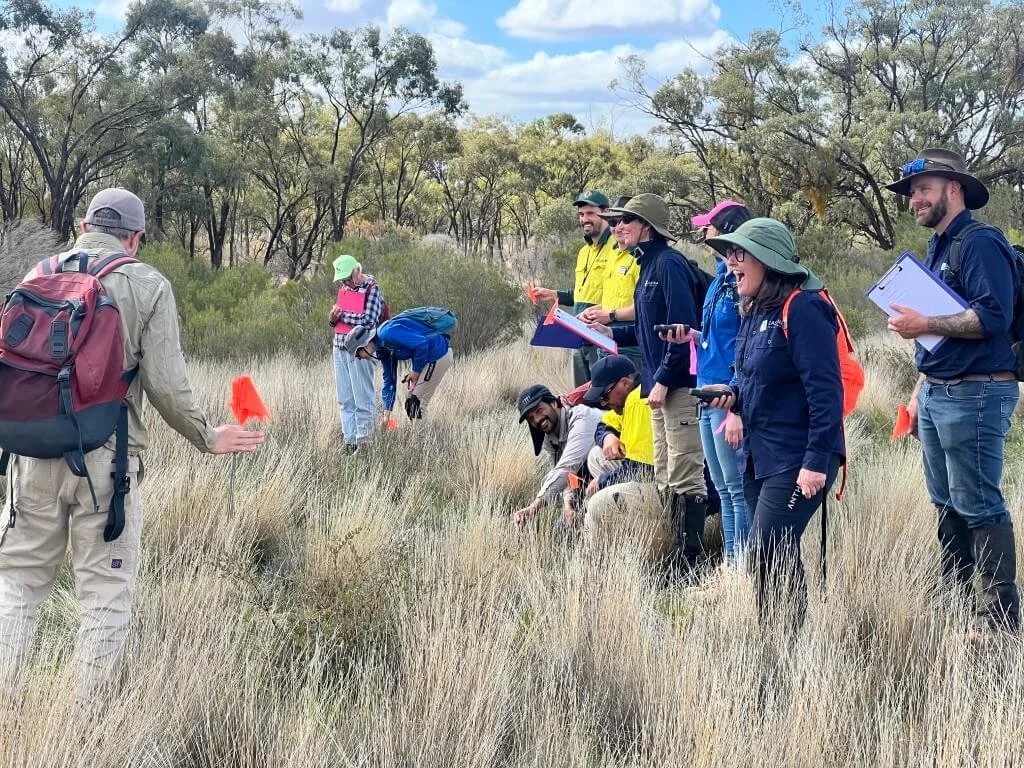
Botanists from the Royal Botanic Gardens of Victoria led the survey and provided such interesting information on the distribution and ecology of this endangered species. But on the day, the Swainson-pea did not play ball. We found hundreds of plants but none were flowering. This meant we couldn’t say with any certainty if the plants were Swainsona sericea, or the (also endangered) Swainsona phacoides.
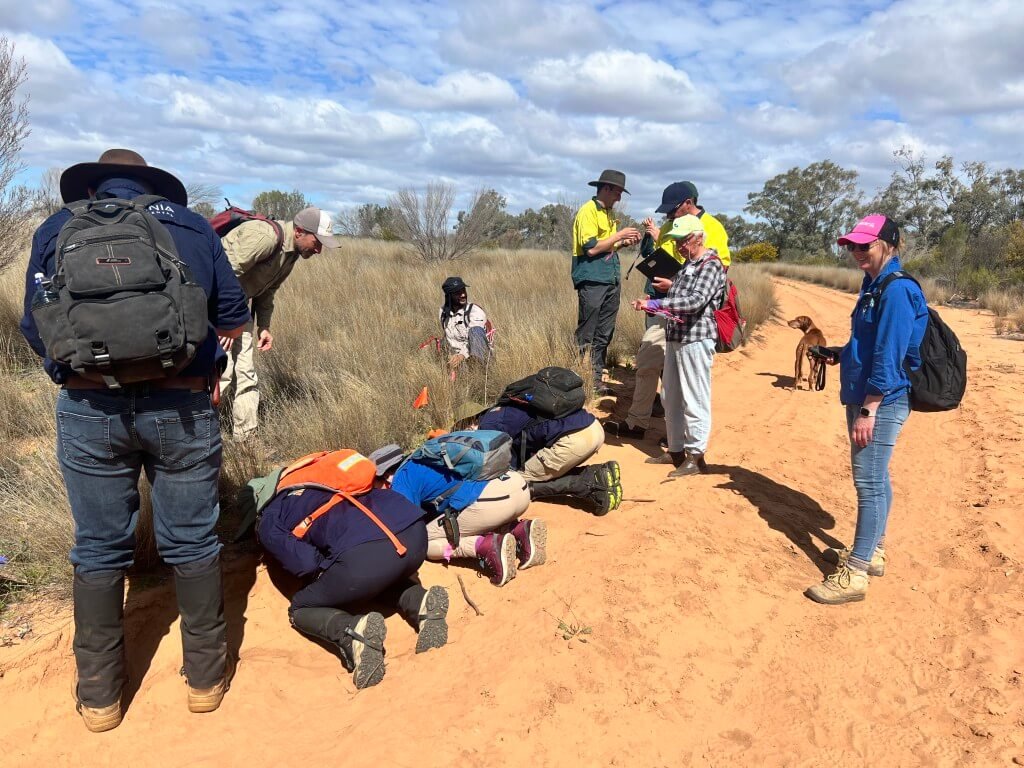
Heads down, bums up - Looking at the tiny Swainsona sericea plants
I had to wait a few weeks until our Swainson-pea flowered and then check whether the style tip was bent (Swainsona sericea), or straight (Swainsona phacoides). I am pleased to report that all of the Swainson-pea we looked at during the field day was the bent-tipped Swainsona sericea (our target species)! So we have several pretty dense populations of this threatened species. Andre's team found 612 plants, Bec's team found 277 plants at their first site and 286 plants at their second. Woo Hoo!!
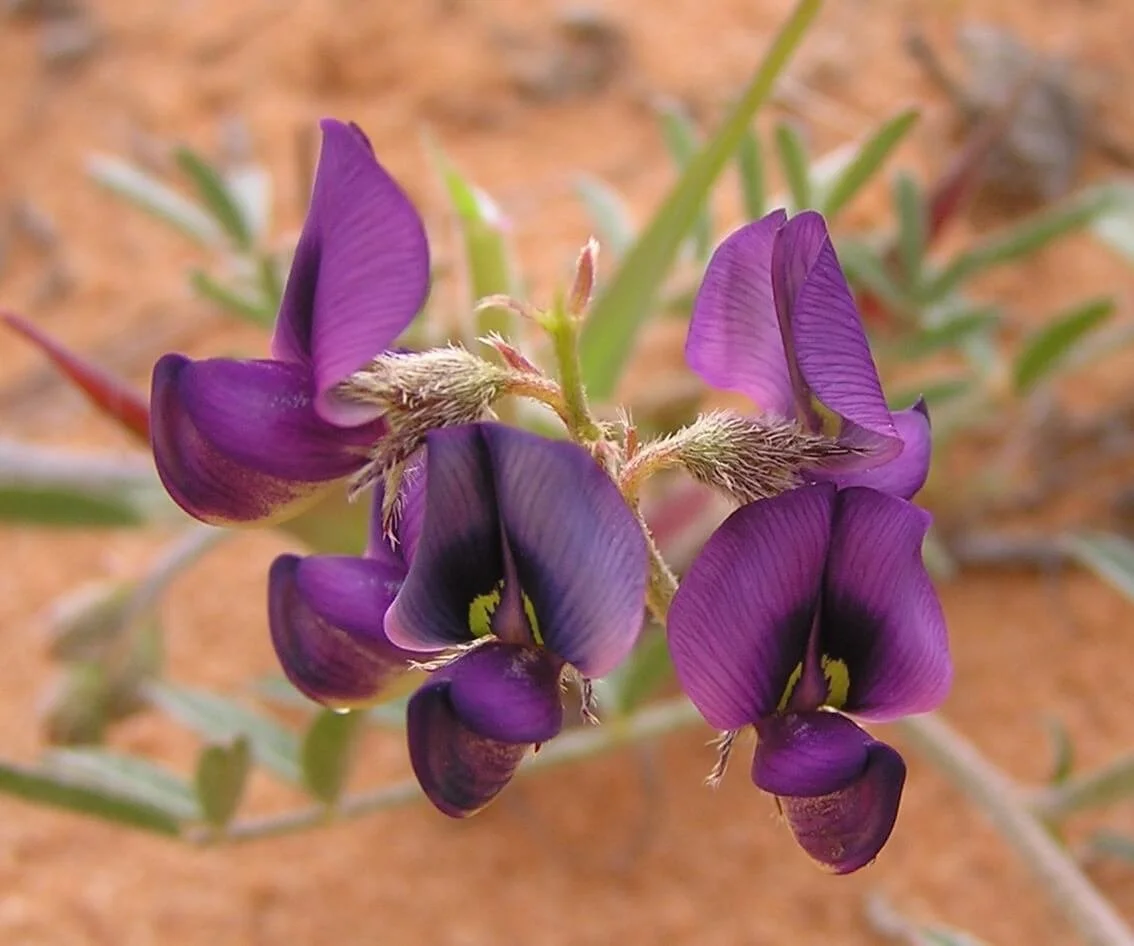
Swainson-pea and their rhizobia
The team from Royal Botanic Gardens of Victoria (RBGV) describe Swainson-peas as "notoriously difficult to grow in cultivation". But these clever folk have developed an inoculum from the root nodules of wild plants. When applied in the nursery, the inoculum produces stronger and faster-growing seedlings. This process works. Look how happy the bloke on the right is with his tray of seedlings.
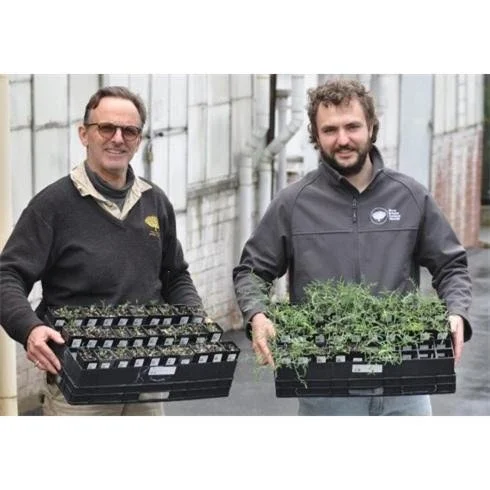
Right: Swainsona reticulata grown with inoculum from root nodules. Left: no inoculum (Thanks to RBGV for supplying the image).
But the plot thickens, because you can’t just brew up a batch of Swainson-pea rhizobia. If you inoculate Swainsona sericea plants with rhizobium from the nearly identical looking S. phacoides … nothing happens.
So, when we confirmed we had a good population of Swainsona sericea growing on Raakajilm, the RBGV folk were keen to return. Alex rushed up from Melbourne, and carefully collected three plants and their roots. He also explained the process of extracting rhizobia from the roots. It is very detailed and precise to ensure the rhizobium is as pure as possible. The methodology is based on that used in orchid conservation translocations. Something like: rinse for 15 minutes, bleach for three minutes, rinse again, then cut open the nodules and pipette out tiny bits onto an agar plate. The rhizobia are on-grown and then the DNA is extracted, sequenced and identified. Finally, the extracted rhizobium can be used to propagate lots of healthy Swainsona sericea plants!
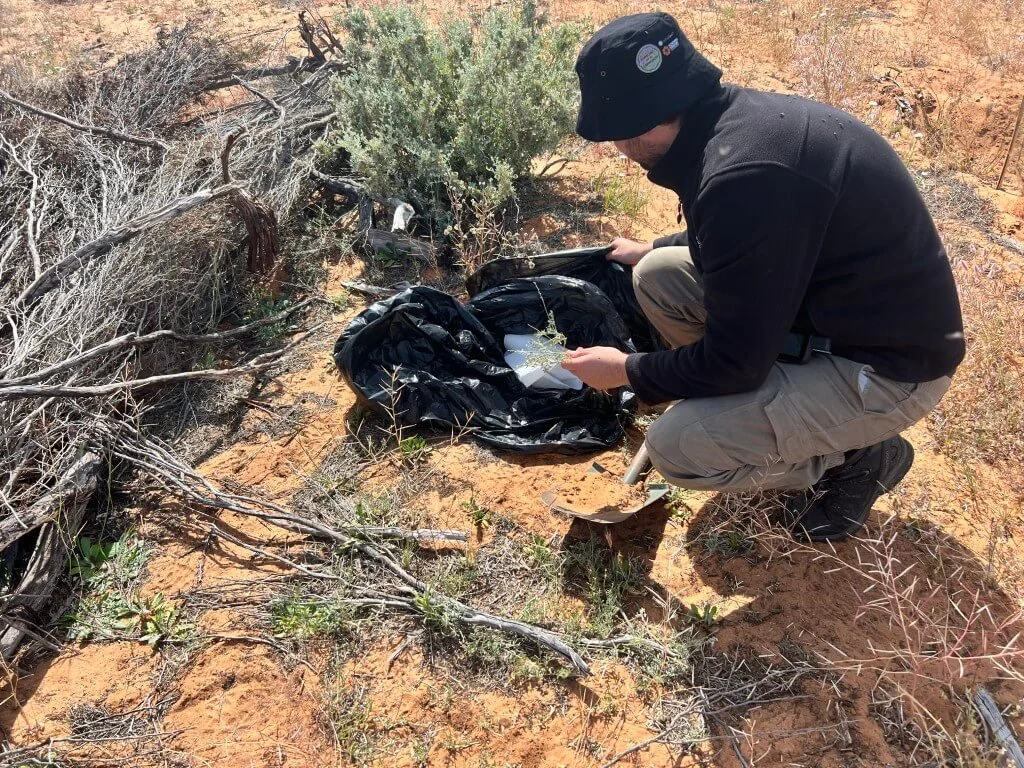
Alex from the Royal Botanic Gardens of Victoria collecting Swainsona sericea plants and their roots to isolate the rhizobium.
Tips for growing Swainson-peas
Useful tips for us bush regenerators wanting to grow Swainson-pea for revegetation:
The plants only need to encounter the rhizobium within the first three months of life. It doesn't need to be present as the seed germinates, or when the seedling is tiny.
We won’t be extracting rhizobia in the laboratory so our best bet is the more hit and miss approach of mixing in a little soil from around established Swainsona sericea plants in with our tubestock. Obviously, please minimise soil disturbance if collecting soil near these rare plants (and permits will be required if you want to collect anywhere other than private land).

How to identify the Mallee Swainson-peas
I learnt a lot from this field day so I wrote it up to share. You’re welcome! Learn more about the Swainson-peas on Raakajilm here: https://www.malleeconservation.com.au/blog/the-swainsona-files
Small-leaf Swainson-pea Swainsona microphylla
Silky Swainson-pea Swainsona sericea
Dwarf Swainson-pea Swainsona phacoides
Hairy Darling-pea Swainsona greyana
Thank you
To Deb from Floodplains and Food who provided us with a delicious vegetarian lunch based on locally sourced produce. Check her out at @localfoodiedeb
To Andre, Bec, Alex, David and Daniel from the Royal Botanic Gardens - your knowledge is incredible.
To everyone who came along to the field day and made it so much fun.

Learn more about RBGV’s Preventing the extinction of Victoria’s threatened flora
This project is supported by the Victorian Government through the Department of Energy, Environment and Climate Action’s Nature Fund.