
Solving our big pig problem
Lots of feral pigs, causing lots of damage, even on the Raakajilm conservation property. Here’s our recipe for getting rid of the pigs.
Trail camera footage of a feral pig feeding at one of our brewed-lure food stations on Raakajilm — the same setup described in the recipe below.
Lots of pigs, lots of damage
Feral pigs tear up bushland with their rooting and wallowing. They disturb soil, destroy native vegetation and turn wetlands into foul-smelling mud puddles. One of the reasons we have an electric fence around Raakajilm is to keep pigs out of our conservation property.
Since the Murray River flood at the end of 2022, pig numbers have increased massively in the Victorian Mallee. There are pigs everywhere on the neighboring properties; Phil recently saw a mob of 45. They love the water and the lush greenness of a citrus orchard or vineyard, and they love hanging out in the adjoining bushland, including Hattah Kulkyne National Park. Pigs are controlled by trapping, aerial and ground shooting in the national parks (when resourcing allows). There are commercial operators engaged to manage pigs on horticultural properties. And then there is us.
Controlling feral pigs on a conservation property
Our electric fence was not operational for several months during the December 2022 flood. And the pigs got in.
Shooting feral pigs on our property is an unpleasant necessity. It’s not a part of conservation work that anyone loves doing, but it’s not an option to let the pigs tear up the bush either. In total, Phil shot 15 pigs after the flood, finally getting the last one in July 2025. But, he spent literally thousands of hours searching for pigs across our 500-hectares.
Then the came the fire in January 2026. It burnt a giant 4 km hole in our fence that took us a couple of months to fix. More pigs got in. Phil has shot nine pigs since the fire, each weighing around 70 kg, but there is still one more. Good news is, he has refined his hunting techniques to something pretty spectacular.
He uses specially brewed pig food to lure the pigs to a food station so he knows where to find them.
Here’s the recipe.
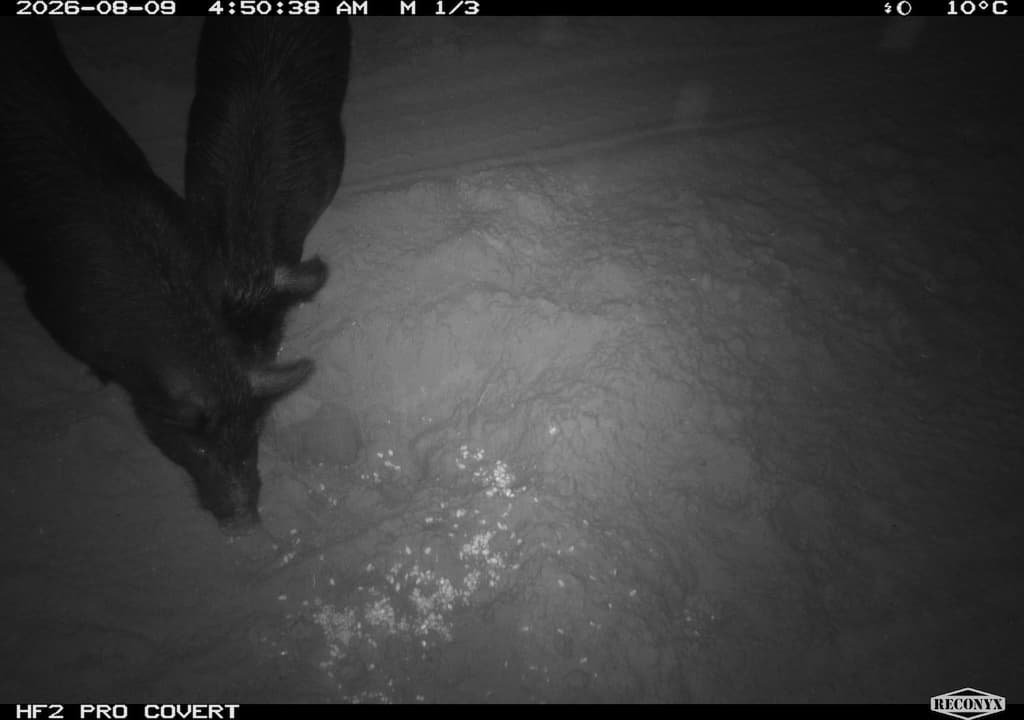
Feral pigs eating the food lure - Phil’s special recipe!
A recipe for getting rid of pigs
Equipment:
Motion activated trail cameras to watch the pigs at the food station
4G enabled motion activated trail cameras that send photos direct to your mobile phone, telling you when a pig is at the free feed
Heated jacket and gloves (for driving around at 2am as temperatures approach freezing)
Thermal monocular (very expensive) to spot pigs from their heat signature (pigs are easily spooked by torchlight)
Thermal scope mounted on a .308 rifle (a very big gun with bullets that cost $2.50 each). Phil has a firearms licence and decades of experience shooting feral animals safely and humanely.
Recipe for pig food:
4 kg corn
2 kg wheat or other cereal grain
2 cups dextrose (can purchase from home brew shops)
3-4 litres of sugary juice (the best he found was a fruit juice with really high sugar content, even higher than cordial!)
24 tsp dried yeast
4 litres of warm water (not hot) to activate the yeast.
Brewing the pig food
Mix all ingredients in a barrel with a lid. There should be enough liquid to cover the grain by about 2 cm. The liquid gets soaked up as the grains expand.
In winter you will need a heat mat to keep the brew warm so the yeast stays activated. We use one that’s designed for propagating plants. This wouldn’t be needed in summer
Let it brew for a minimum of 3 days. After one day the mixture should be off-gassing with little bubbles. After two days it starts to ferment and develop a sour smell - this is what the pigs want. But beware - after three days it really stinks.
This recipe is an adaptation of many online recipes, including one from the Texas “Pork Police”.
Setting up a food station lure for pigs
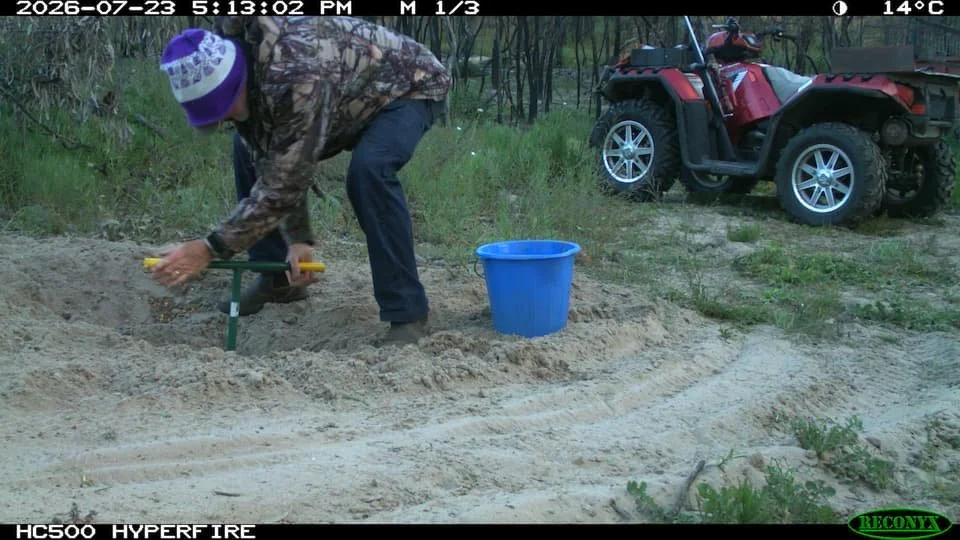
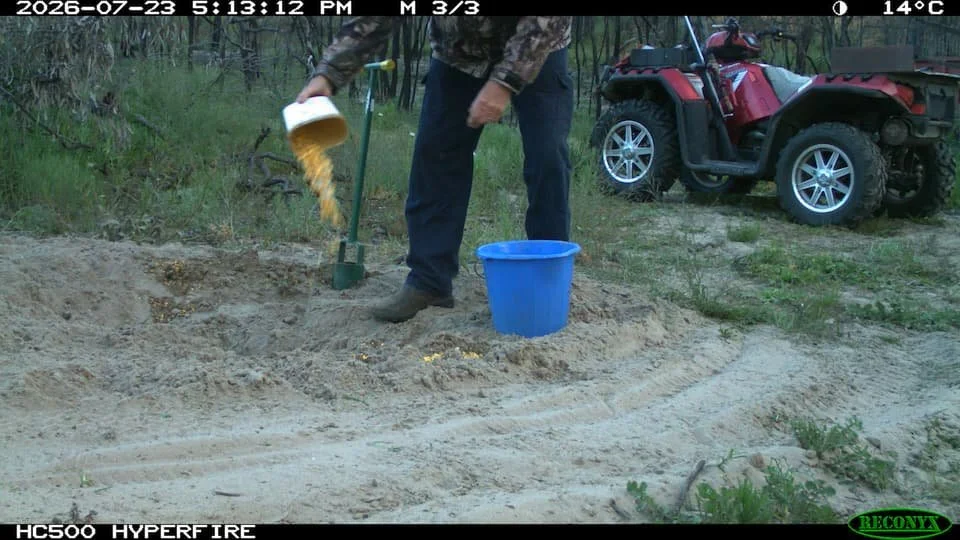
Dig a 700 mm deep hole with an 10 cm hand post-hole auger.
Drop about 3 litres of the brewed food into the bottom of the hole. Sprinkle a handful on the surface around the hole.
Add 100 mL molasses. Spread it around on the sand or nearby bushes - extra perfume.
Use a motion activated camera to monitor the behaviour of the pigs at the food. You want them to be spending at least 10 minutes every visit rooting around looking for the food. That’s why the holes are so deep, so the pigs have to work to dig the food out.
When the pigs have discovered the brew and are coming in reliably, set up a 4G enabled motion activated trail camera to send a message to your mobile phone when the pig is at the food. If you can get your response time down to around ten minutes, you have a chance to shoot the pig whilst it is busy eating the pig food.
Pigs can turn up at anytime during the night so a ping at 2 am sees Phil leap out of bed, put on some warm clothes, including heated jacket and gloves, and drive off to see if he can shoot the pig. He’s not always successful but it’s a lot easier than driving around all night hoping to encounter a pig by chance.
The pigs might take a few days to find the food initially, maybe up to 10 days. But once they discover the brew, they love it. The pigs will visit a food station every night for 3-4 nights, even after all the food has been eaten. Fresh brew generally gets taken on the first night it is out. Phil has never had free feed taken this well by pigs.
Good luck!
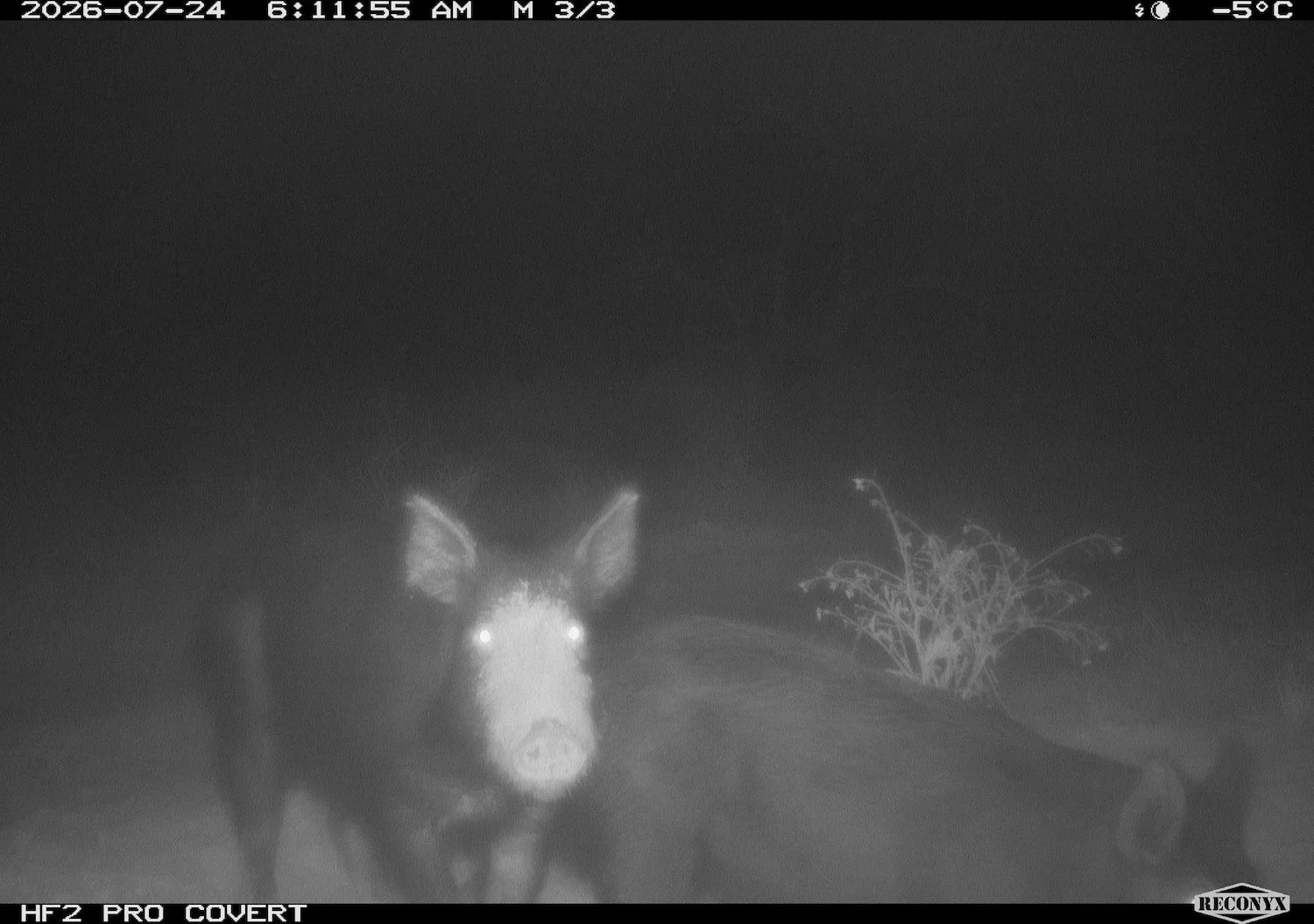
Pigs, dogs and community action
Like any pest, minimising the damage caused by pigs will be most successful if everyone is working together. Pigs move between us, Hattah-Kulkyne and adjoining horticultural properties. There are several examples across Australia of landholders working together to share information, pool equipment like traps and coordinate control, using FeralScan to track where pigs are turning up (Kangaroo Island is now pig free - YAY!). If we could do this we would stand a much better chance of getting on top of the pigs.