
Honey, I fed the ants
After a bushfire, you sometimes hear about helicopters dropping hay and carrots for hungry Brush-tailed Rock-wallabies. But I don't think I've heard of emergency feeding to sustain ant colonies!
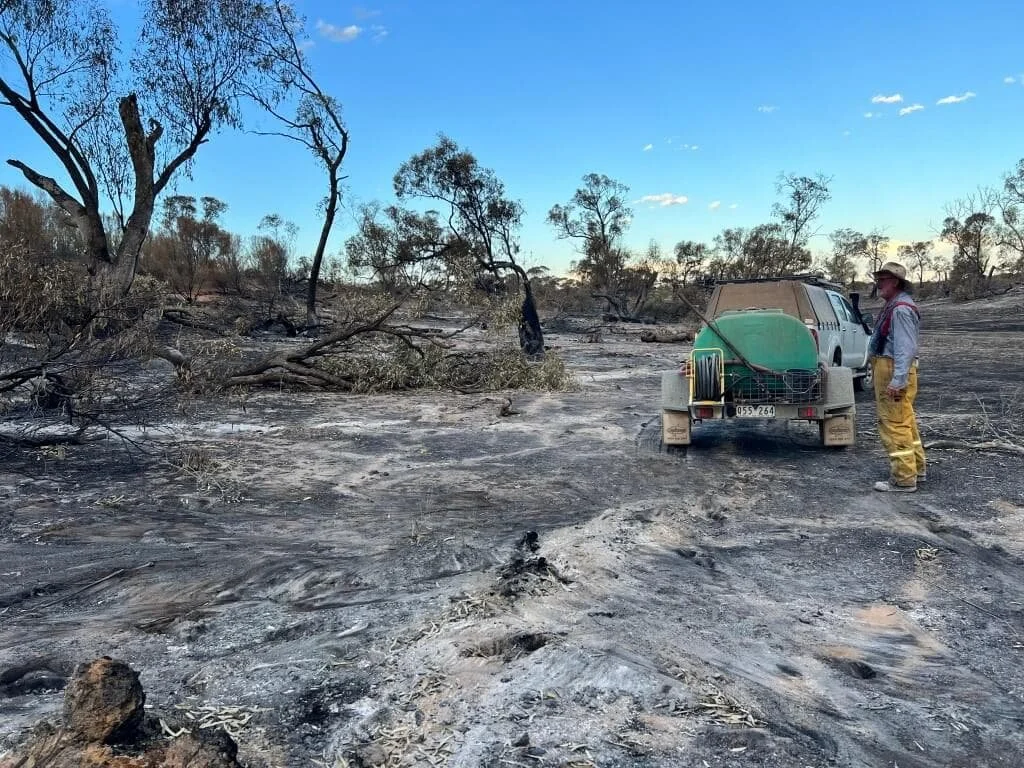
Raakajilm Creek after the fire - most of the Blackbox trees were killed.
Why would you feed ants?
On 9 January, a bushfire burnt more than 900 hectares, including 130 ha of Raakajilm, our conservation property on the northern edge of Hattah Kulkyne National Park. Thanks to an emergency grant from Trust for Nature and DEECA, we spent the next few months cooking dinners for the Sugar Ants that look after our Mallee Bronze Azure butterfly. Yes, really.
No ants, no butterflies
The Mallee Bronze Azure (Ogyris subterrestris) can't survive without their host Sugar Ant (Camponotus terebrans). The caterpillars grow up inside an ant nest, often at the base of a Blackbox tree. And the butterflies are fussy: they only lay their eggs on a living tree with a busy ant nest at its base.
About 30% of the Blackbox trees along Raakajilm Creek showed some signs of life after the fire. But, although most of the ants would have survived the fire by sheltering underground, the post-fire landscape was low on ant food.
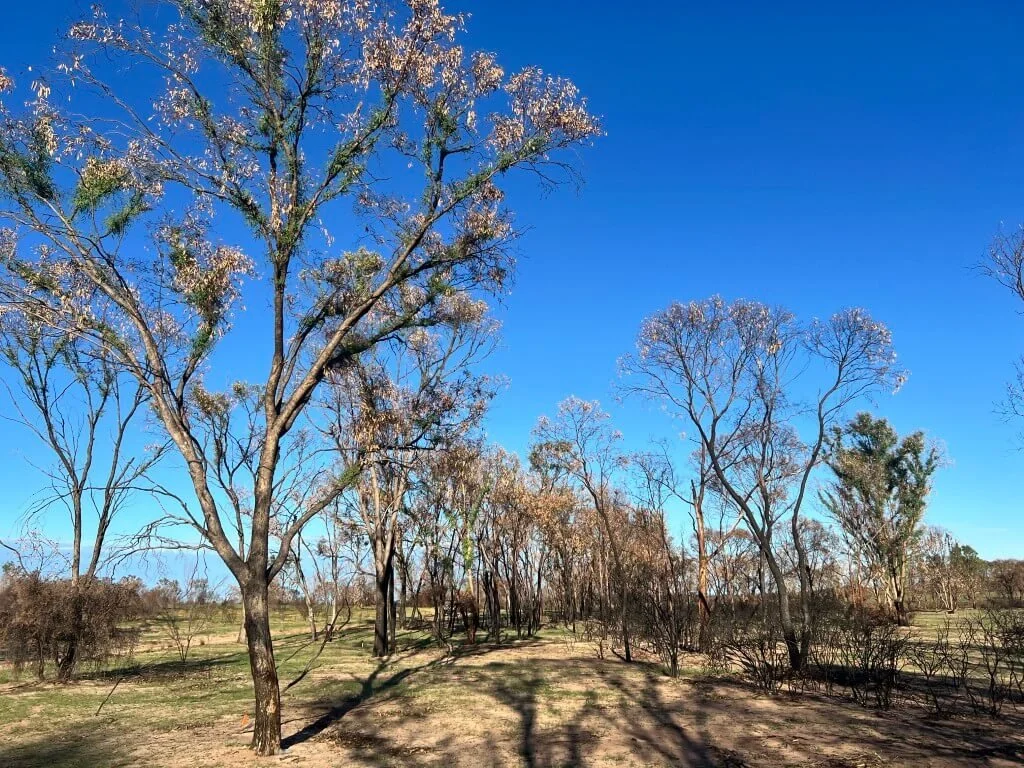
It took about two months after the fire for some leaves to grow back on the trees.
What do ants eat, anyway?
A bit of everything really. Sugar Ants forage on insects and carrion, and have worked out how to get nitrogen from animal urine and bird droppings. They really love sweet stuff, like nectar from flowers and especially honeydew, a sugary energy drink made by sap-sucking insects like leafhoppers.
But after the fire there were no leaves on the trees, and few insects, particularly the sap-suckers, so no honeydew.
Honeydew, homemade
So, with advice from Zoos Victoria, we cooked up our own high-nitrogen honeydew. We based it on the "ant jelly" sold for rearing ants in ant farms. Ripe banana, honey and sugar supply the carbohydrates. Fancy air-dried venison (only the best for our ants) and Wombaroo insectivore powder supply the protein. A little urea adds extra nitrogen. Agar jelly holds the whole lot together. (The recipe is below, in case you ever find yourself catering for a creekline full of hungry ants).
I was making about 60 trays of food a night: my hungry ants were polishing off more than a kilogram of jelly every night. That's 28 bananas a week!
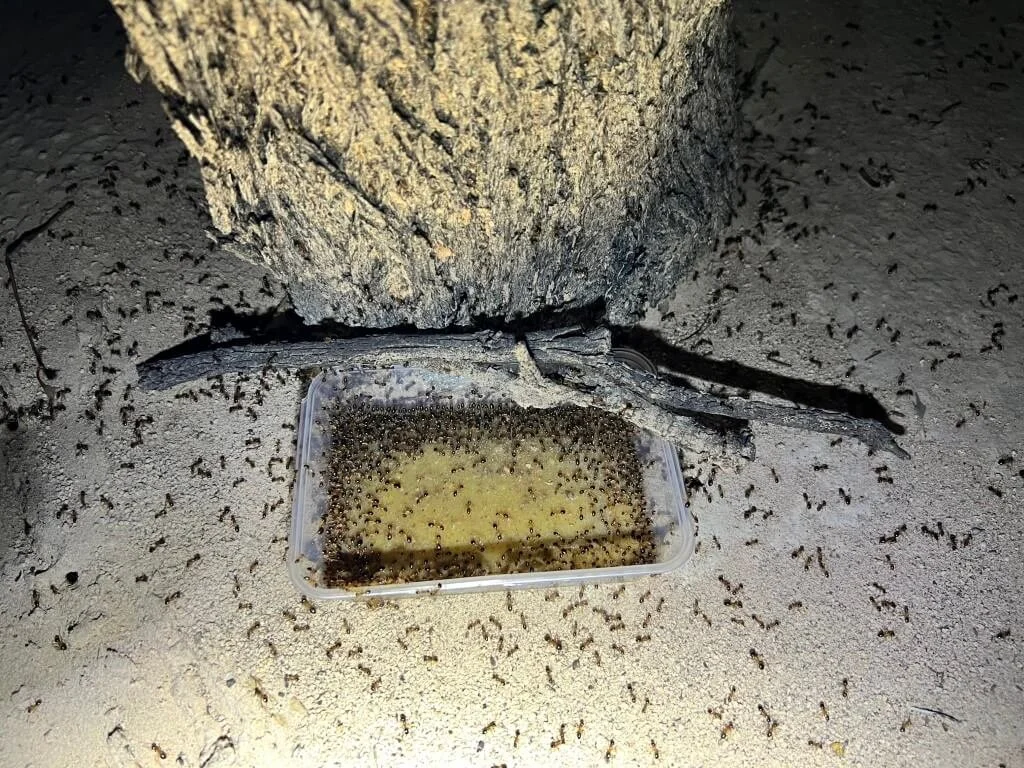
After the fire I was amazed at how many Sugar Ants came in to feed from the trays of ant jelly.
Backing the winners
Since the butterflies only use ant nests at living trees, I walked 3 km of burnt creek line, counting and tagging every Blackbox with a few green leaves. From those, I picked 165 trees where the ant nest at the base looked strong. They each got a tray of jelly every third night for about two months.
Sugar Ants are nocturnal so I put the trays out in the evening and collected the leftovers early in the morning. If I didn’t, the jelly would attract the day-foraging Meat Ants (Iridomyrmex sp.). These are aggressive competitors with Sugar Ants so I didn’t want to feed them!
The feeding was designed to be supplementary, not a full replacement diet, and only temporary. The aim was to support the strongest colonies immediately post-fire, so they'd still be around to look after the butterflies.
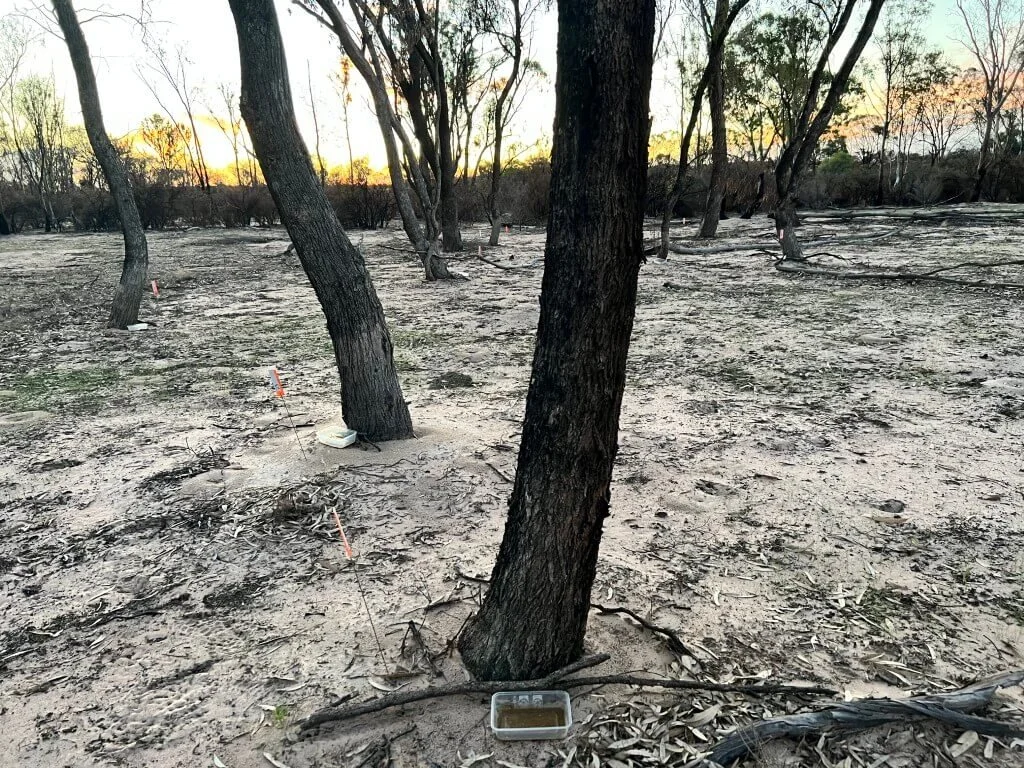
The post-fire landscape on Raakajilm. At the base of each tree is an ant nest - and a takeaway dish of food!
And then it rained
In early March, a miracle: 130 mm of rain in one big drenching (nearly half our annual rainfall!). By mid-March the Blackbox had new leaves, some insects were back, and the ants could fend for themselves. I closed the ant kitchen.
In May I searched the living trees along the creekline and found butterfly eggshells on 16 trees. The caterpillars that hatched from those eggs are probably still underground in the ant nests, growing into this spring's butterflies. So by feeding those ant colonies I hope we were looking after the next generation of butterflies too.
This spring I’ll be surveying both ants and butterflies. Fingers crossed the butterflies come back to lay. I'll let you know!
Fiona's ant jelly recipe
Sharing this in case it helps someone else. If you're planning something similar, have a chat with your local experts first. Zoos Victoria were a huge help to us.
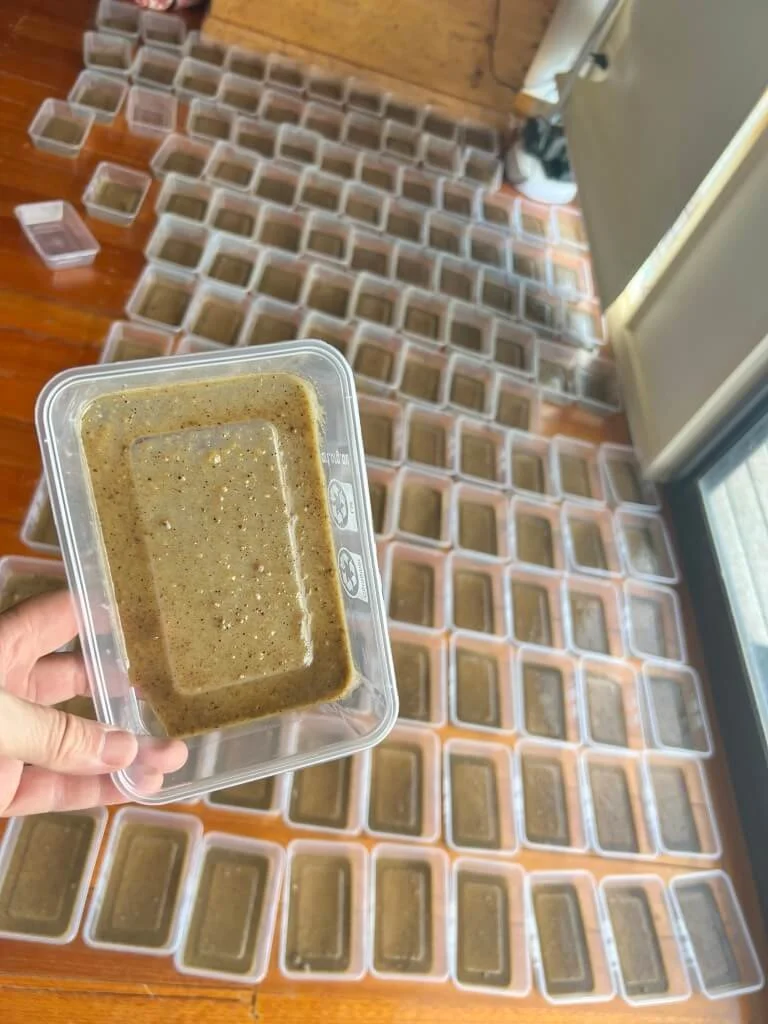
Trays of ant jelly. I made a batch every night for two months!
Makes enough for about 60 trays.
Agar mixture
Mix 2 tsp agar powder into 2 cups boiling water and boil for 2 minutes, stirring.
Jelly mixture
• 40 g Ziwi Peak cat food (air-dried venison). Blend in a Thermomix for 10 seconds on speed 7.
• 4 bananas
• 160 g dark brown sugar
• 20 g honey
• 60 g Wombaroo insectivore powder
• 2 cups water
• 50 g urea
Add all ingredients into Thermomix, including the agar mix. Bring to the boil at 110°C on speed 2 for 6 minutes.
Pour about 1 tbsp (20 mL) into each rectangular takeaway dish. The ants can eat up to 30 mL from a tray overnight. Leave to set and put out that evening.
Make it fresh each day. It can't be stored or reboiled. (Believe me, it just doesn't work.)
Thank you
A huge thank you to Trust for Nature for the emergency grant that made this possible, and to Zoos Victoria for carefully thinking through the risk assessment, then helping us get the recipe right.