
Murnong - the Yam Daisy
It’s September and the Murnong are in flower in the Mallee. Also flowering are our plants grown from wild-collected tubers and seeds. We are propagating these so that one day our grasslands will be full of Murnong again.
Identifying Murnong (Yam Daisy)
At first glance, Murnong can look like some common yellow daisy weeds like Dandelion or Cat's Ear Flatweed. The key is to look for the nodding flower buds of the Murnong which droop down until the flower opens.
Canberra permaculture article on distinguishing Murnong from common weeds
Murnong are a Spring-flowering yellow daisy which resprouts each year from thick tuberous roots. The roots were a staple food for indigenous Australians right across south-eastern Australia. There are many records of the plants being cultivated and harvested at the time of European settlement. Sadly, the plants suffered from over-grazing, particularly by rabbits and sheep. Today, the best place to find Murnong in the Mallee is deep inside a Porcupine Grass (Spinifex) tussock where the prickly leaves provide protection from herbivores.

A patch of Murnong in the Mallee growing amongst Porcupine Grass (Triodia scariosa), note the drooping flower buds.

The flowers are large - up to 6 cm in diameter

By October, the Murnong have finished flowering and the fluffy seed is ready to blow away.

Murnong seed head
Propagating Murnong (Yam daisy)
A recent taxonomic revision increased the number of Murnong species in Victoria from two to three: Microseris walteri across central and western Victoria, M. scapigera in the south-westand M. lanceolata in the east. Our Mallee Murnong is Microseris walteri and these plants produce the longest tubers, up to 8 cm or more.
Taxonomic revision: Walsh, N.G. (2016). A name for Murnong (Microseris: Asteraceae: Cichorioideae), Muelleria 34: 63–68.
I've learnt some new tricks when growing this species for revegetation. Collect seed in October and sow fresh seeds the following March. This allows time for the tuber to grow large enough so the plant can flower in September.
You can plant them out in August but be gentle! Don't disturb the roots. They will flower, but they may not have developed a large enough tuber to resprout next year. Hot tip: You can keep them in their pot and plant them out in their second Spring. This allows time for the tuber to grow and develop into a perennial resprouter.
Even with this tip, I find it hard to establish Murnong in the bush.

The ill-fated Murnong before I divided the tubers

A large plant with tubers which I successfully killed by dividing it whilst it was actively growing. Wait until the plant is dormant before dividing!
Growing Murnong - resources
Excellent video on re-establishing the southern Murnong (Microseris scapigera) along Merri Creek
2021 article in Victorian Landcare Managezine Growing and transplanting murnong - a cultural and commercial crop
There is a Murnong Growers Facebook group who are very generous in sharing their knowledge.
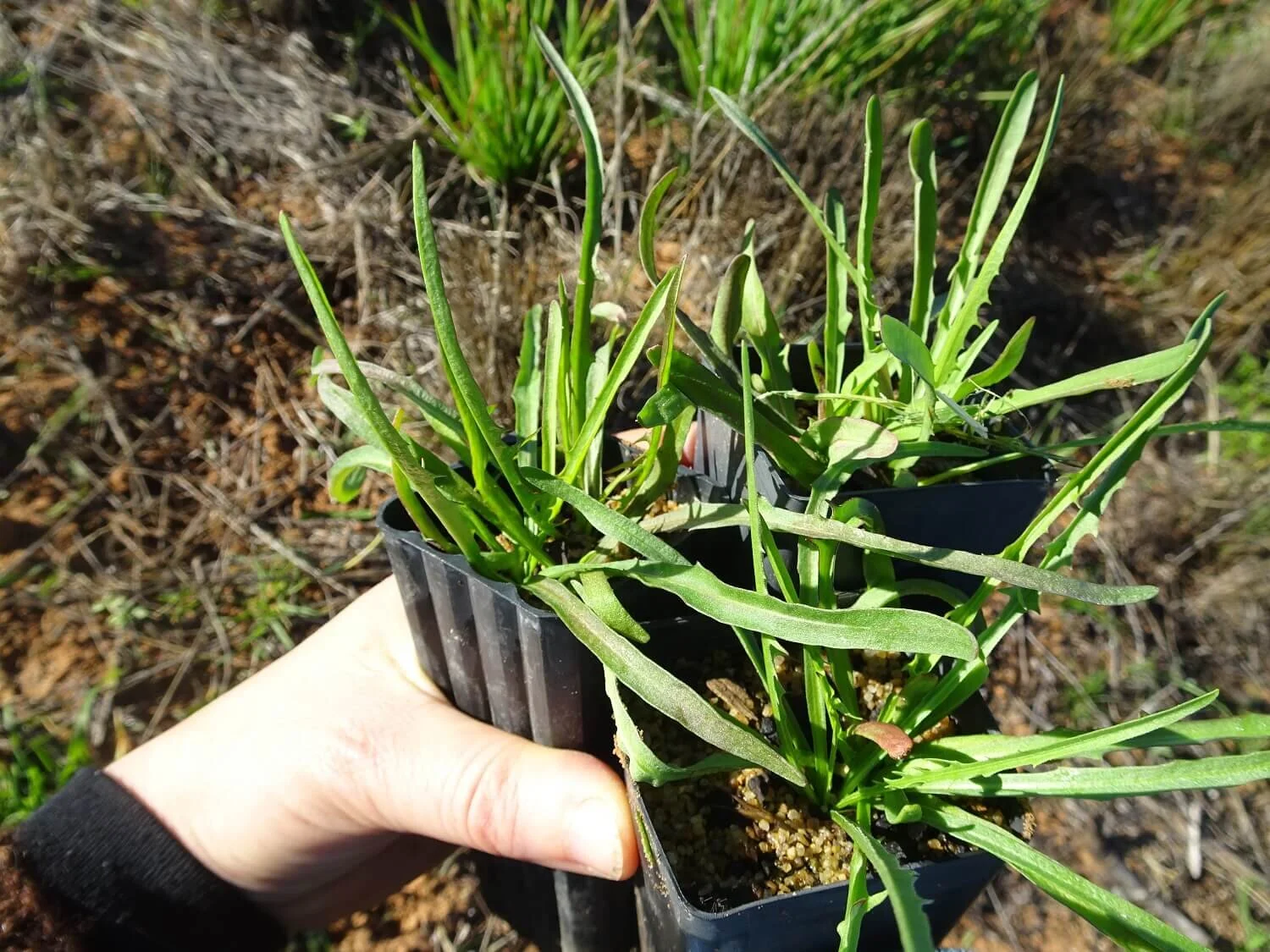
Murnong ready for planting
Use of Murnong by First Nations people
Historian John Burch has evidence that Aboriginal people used yams in the Victorian Mallee, (Kulkyne Station is right near us):
In 1848 a naturalist, Edwin Bunce, visited Kulkyne Station while travelling along the Murray. He later published an Aboriginal dictionary. In it he had the words myrrnong kalk which he mistranslated as walking stick. He had clearly seen Aboriginal women heading off with their yam wood to gather a harvest and thought their digging tool a stick.
John Burch has written extensively about the Victorian Mallee, including in the book "Returning the Kulkyne". On page 135 of the book, there is a picture of a woman holding her Yam Stick across her knees.
Cultural use of Murnong - resources
Aboriginal Victoria Youtube clip on cooking Murnong in earth ovens - amazing how many tubers were collected
Fascinating post from botanist John Morgan about the Aboriginal use of Murnong and inspiration to “re-yam the plains”
Friends of the Geelong Botanic Gardens detailed overview of use for food, distribution and taxonomy
First published September 12, 2020. Updated September 24, 2021.