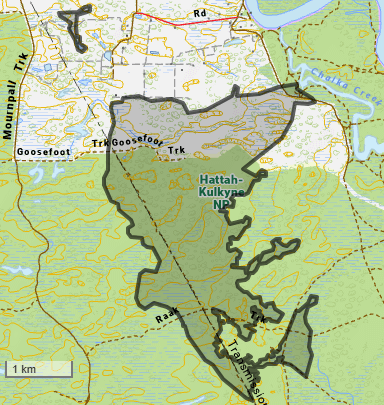
The 9th January 2026 really was a terrible day. It was the day a bushfire burnt 160 hectares of the Raakajilm conservation property, plus hundreds of hectares in Hattah Kulkyne National Park.
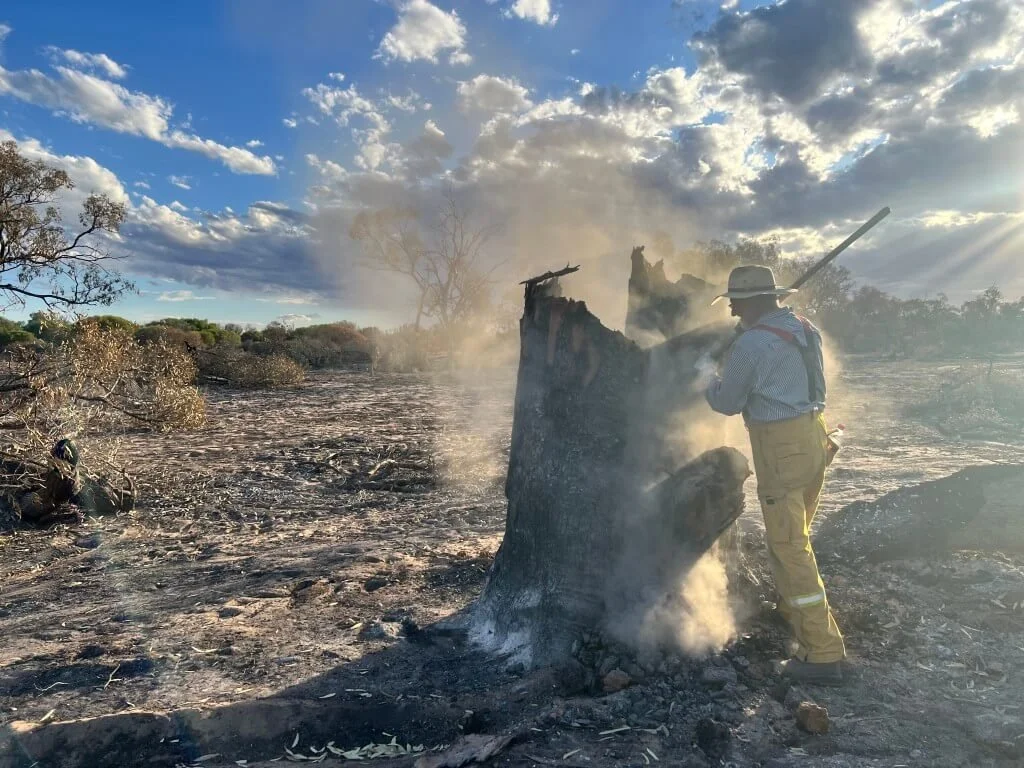
Blacking out some of our big, old trees that were destroyed in the fire.
The fire started in the irrigation property to the north of us. It felt like only minutes after seeing the smoke that I heard Phil say “It’s gone. It has spotted into our bush.” The spotting distance was more than one kilometer. We’ve since looked back at photos and Phil estimates the spot fire was travelling around 17 kph as it took off heading south towards Hattah Kulkyne National Park.
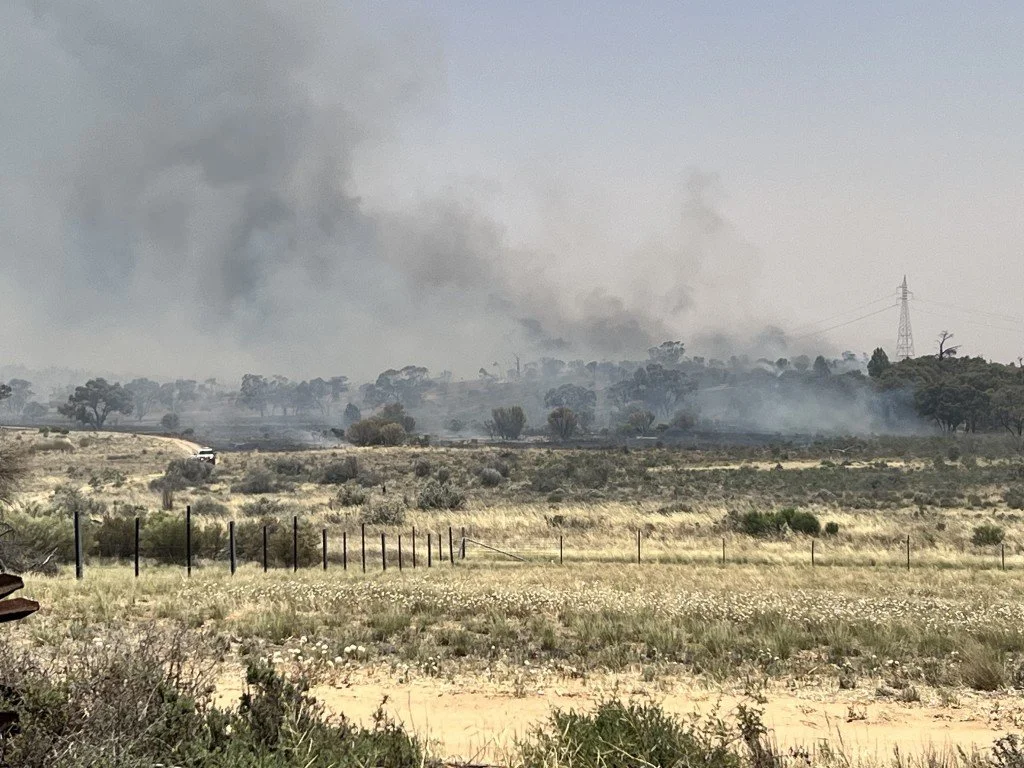
Looking south from our house as the spot fire took off.
We were surrounded by CFA trucks and volunteers. Forest Fire Management Victoria sent in a CTL (bobcat), and then a dozer, trying to cut a fire break to contain the fire. But the FFMVic air observer alerted us to the wind change approaching rapidly. The predictions he made were uncannily accurate, describing how the wind would affect the fire. As predicted, the south-west wind change pushed the fire back to the north-east and back into Raakajilm. It went roaring along our Blackbox creek line until it reached the floodplain of the Murray River, eventually burning 940 hectares.
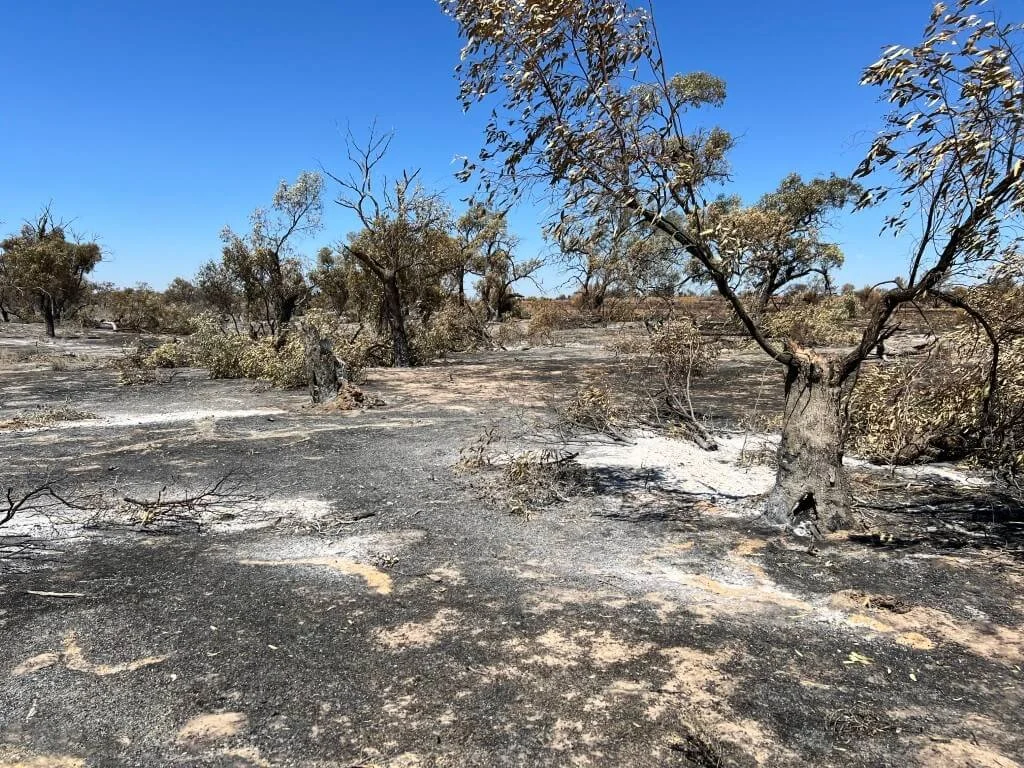
Our beautiful old Blackbox (Eucalyptus largiflorens) trees in the creek line were burnt to the ground.
We did have two small wins:
The Nangiloc CFA managed to prevent the fire from crossing into the western third of our property, so our wetland and a large area of Blackbox is unburnt thanks to them.
At 2am Phil and I, assisted by the Irymple CFA, managed to put a fire break in our Mallee woodland using our tractor. Although Mallee woodlands are resilient to fire, if our patch of Mallee had burnt fully the fire likely would have threatened houses to the north of us. We were also determine to protect a population of Mallee Bronze Azure butterflies and their host ants.
But otherwise, it was mostly devastation. Our Blackbox woodlands and Pine woodlands do not respond well to fire. Also burnt was 53 hectares of revegetation, planted over the last 20 years and four kilometers of our electric fence.
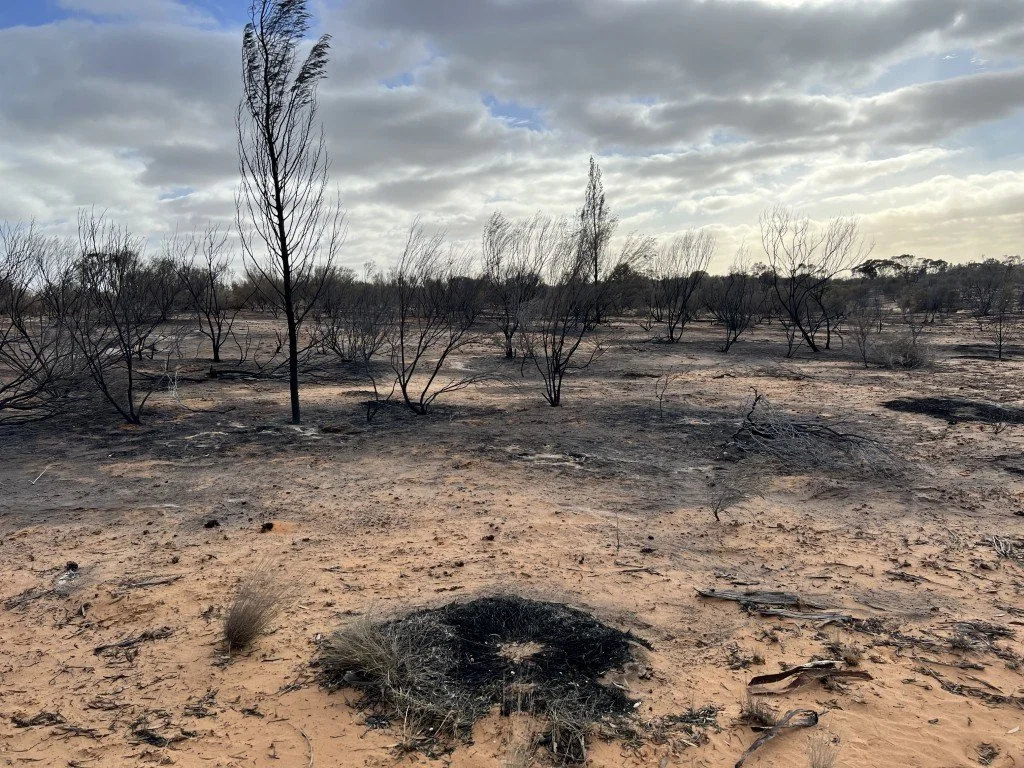
Native Pine trees (Callitris gracilis) are the tallest trees in this photo. Sadly these trees are killed by fire.
In the weeks immediately after the fire we spent our time putting out stumps and logs, trying to save as much coarse woody debris as possible. If we didn’t extinguish the logs they continued to smolder until they disappeared into white ash. I couldn’t believe that two months after the fire I could still see a red glow in stump holes where the fire still smoldered.
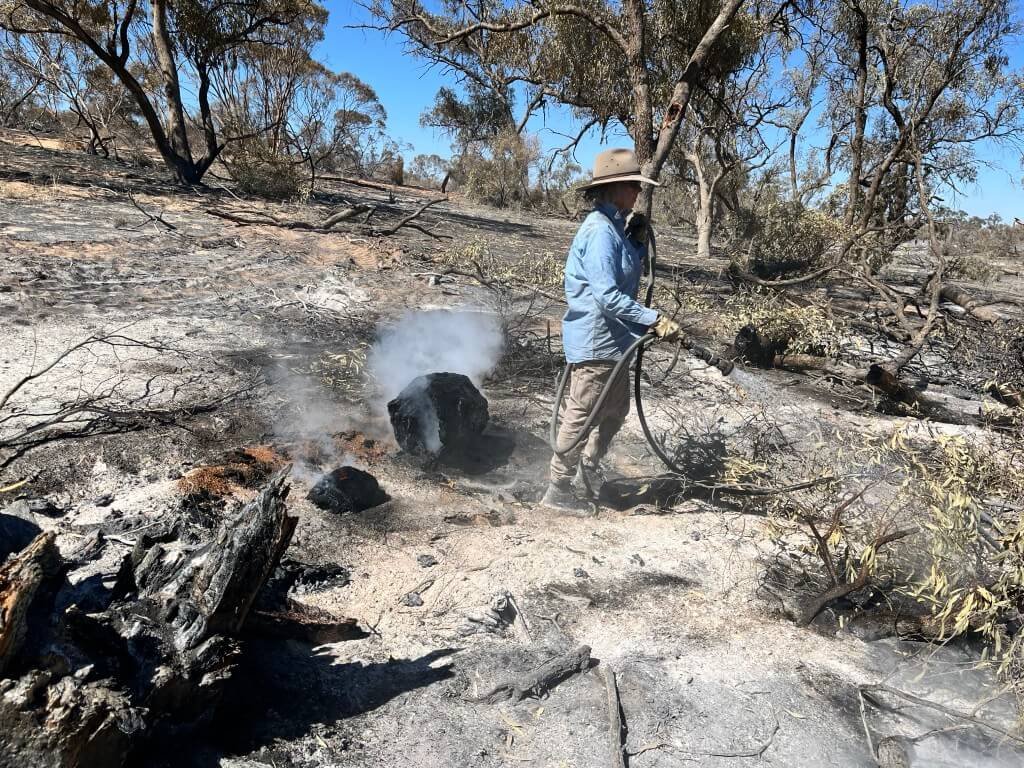
Endless blacking out.
There were many conservation properties impacted by bushfire this summer and our hearts go out to others affected. We also acknowledge the deep sadness many of us feel for special places that were impacted by bushfires, like the Pine Plains fire in Wyperfeld National Park that destroyed so many nest trees for the Pink (Flame-crested) Cockatoo.
(Although this post is dated 9 January, I couldn’t actually bring myself to write this until mid March.)
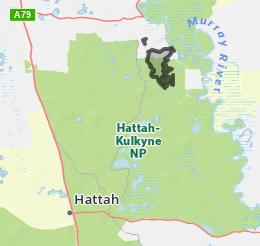
Map of the fire (black)
The origin of the fire is the small area in the north-west (an irrigation property). The fire spread to the north end of Hattah Kulkyne National Park.