
Predators, pathogens and parasitoids
The three Ps (predators, pathogens and parasitoids) are natural control agents that can mean the end of an insect outbreak. Here are three contenders in “Nature Fighting Back vs. Mallee Looper caterpillar”.
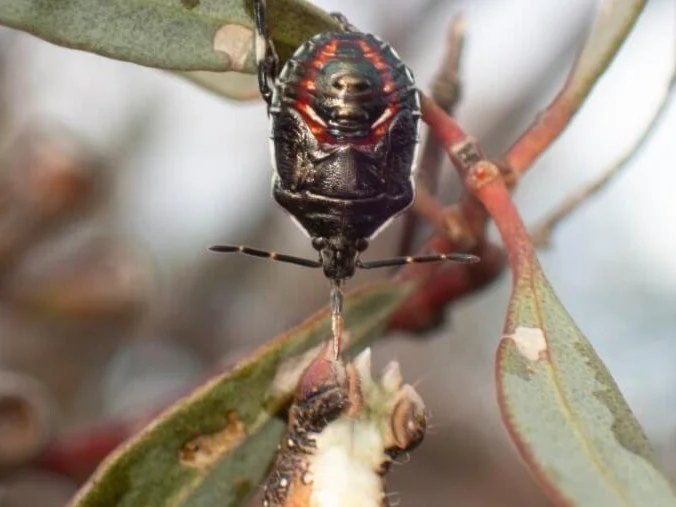
The fifth and final instar of a Schellenberg’s Soldier Bug, sucking on a Mallee Looper caterpillar
Predator - Schellenberg’s Soldier Bug
Oechalia schellenbergii
These guys are my favorites. They are a predatory shield or stink bug and one of the most common predatory insects in Australia. There are five nymphal stages before they reach adulthood, and all except the first instar nymph feed on caterpillars. The bugs have sucking mouth parts and stab their prey with two tubes. One tube pumps saliva into the prey, and a larger tube sucks up the partly digested prey. Yummy!
I found them slurping away on Mallee Looper caterpillars. The caterpillars were hanging around, looking deflated; sucked dry I guess. The Soldier Bugs (mostly nymphs) were still attached.
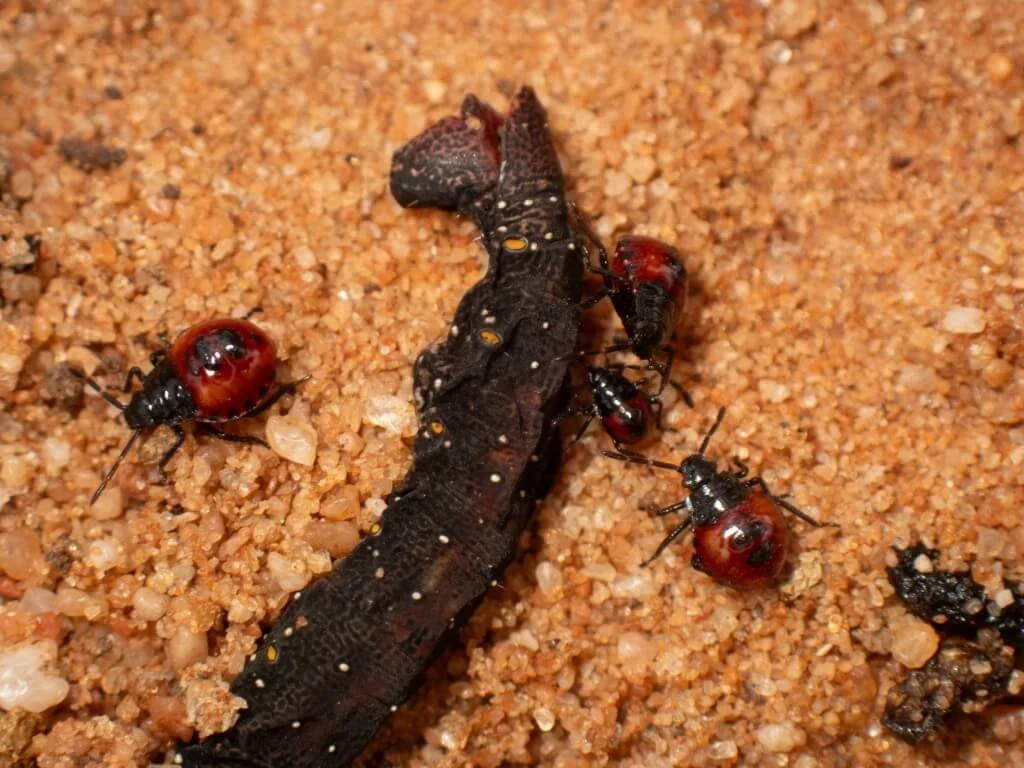
Young Schellenberg’s Soldier bugs with the deflated remains of their Mallee Looper prey.
These guys overwinter as adults. The eggs are black with white spines. Super cute actually. Eggs are found between December and March. Hatching just in time to feed on the Mallee Looper caterpillars.
Biocontrol potential: These bugs are slow breeders compared to the rapid appearance of Mallee Looper caterpillars, so are unlikely to end the outbreak on their own. But Schellenberg’s Soldier Bugs are also known to feed on caterpillars that are infected with NPV, a caterpillar killing virus (below). The virus is highly infective on mouthparts and in the poo of the bugs for a couple of days after a meal. This means the bugs don’t just kill their prey caterpillar, but can spread disease amongst other caterpillars by contaminating the leaves caterpillars feed on.
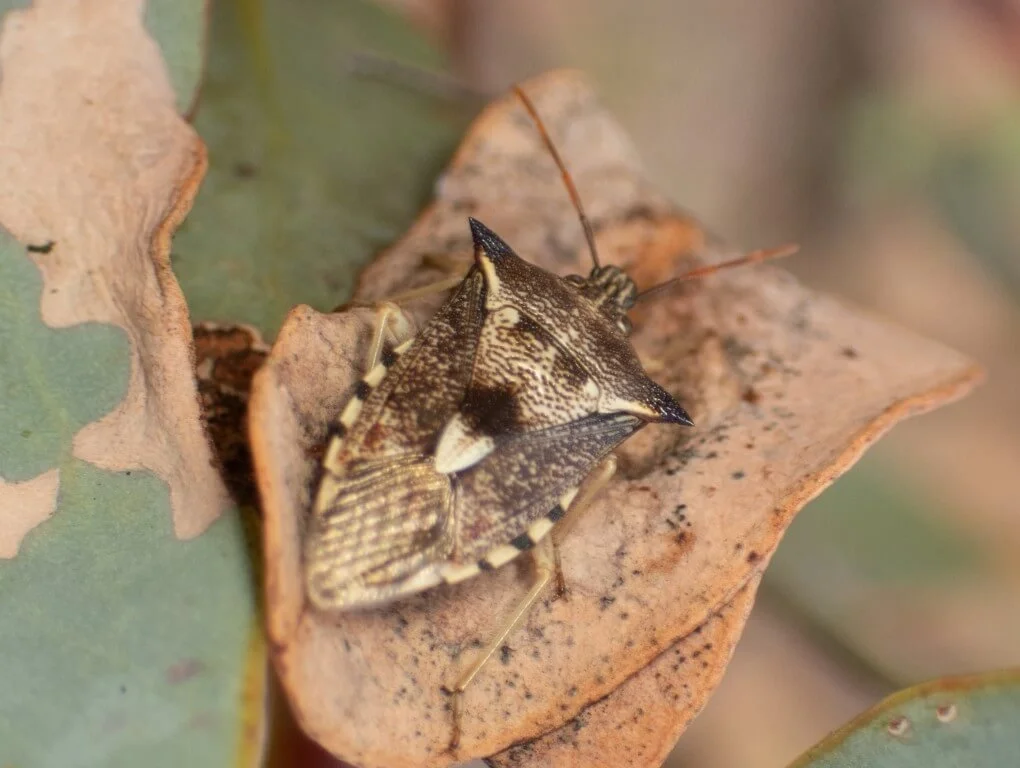
An adult Schellenberg’s Soldier Bug (also called a Spined Predatory Shield Bug)
Pathogens - Viruses, fungi and bacteria
Pathogens are disease-causing microorganisms that usually kill the host.
Nuclear Polyhedrosis Virus (NPV) or Black Death
There are a whole range of viruses that kill or reduce the fitness of their caterpillar hosts (NPV, CPV, GV, EPV - you get the picture). NPV is a common, caterpillar-specific virus of moths.
Method of spread: NPV causes caterpillars to climb upwards, hang and then die. Actually, they don’t just die, they melt and liquify into a stinky puddle of dark black liquid. This Black Death rains down on leaves below and spreads to other caterpillars when they eat the contaminated foliage.
Appearance: Cadavers are limp, often hanging from an elevated location. They darken in color after death and can become bloated. Skin ruptures easily and body liquefies. Foul odour.
Biocontrol potential: NPV is killed by sunlight but otherwise can remain viable for years. Some strains of NPV are commercially available as a biological control agents for specific pests, such as for Helicoverpa (Budworm moths).
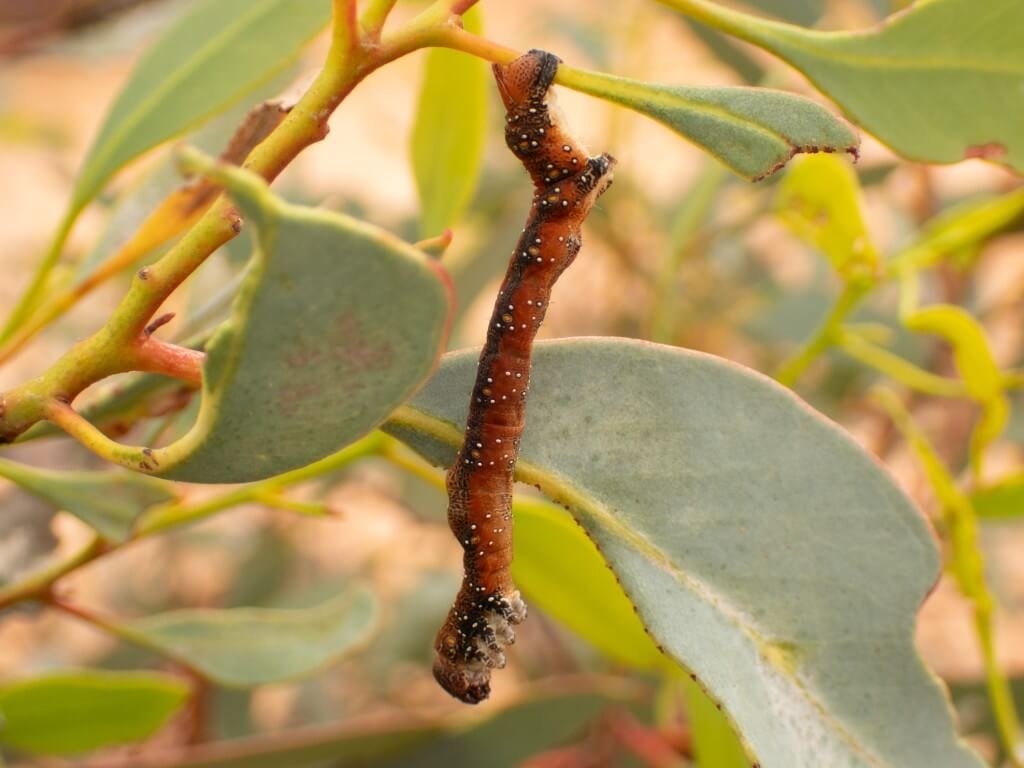
A dead Mallee Looper caterpillar hanging by its anal claspers. Killed by an unidentified pathogen, possibly an EPF.
Entomopathogenic Fungi (EPF)
EPFs are parasitic fungi that infect and kill their hosts. Common EPFs include Beauveria spp. Entomopthera spp. and Metarhizium spp.
Method of spread: Fungal spores infect caterpillars on contact. The fungal hyphae grow throughout the host’s body and millions of spores are produced, causing a fuzzy layer to grow on the skin of the caterpillar. The spores are are spread by the wind. The caterpillar food plant can influence the prevalence of EPF.
Appearance: The caterpillar becomes spongy and may show dark spots where the fungi entered. After death the caterpillar cadaver dries out, and stiffens, becoming covered with fuzzy growth. Generally has no foul odour. Entomopthera produces a white, cauliflower-type growth.
Biocontrol potential: In nature, fungi are more successful in moist or humid environments. Mass production of fungi is difficult and has a limited storage life outside the host. However, Metarhizium is produced as a biocontrol for locusts.
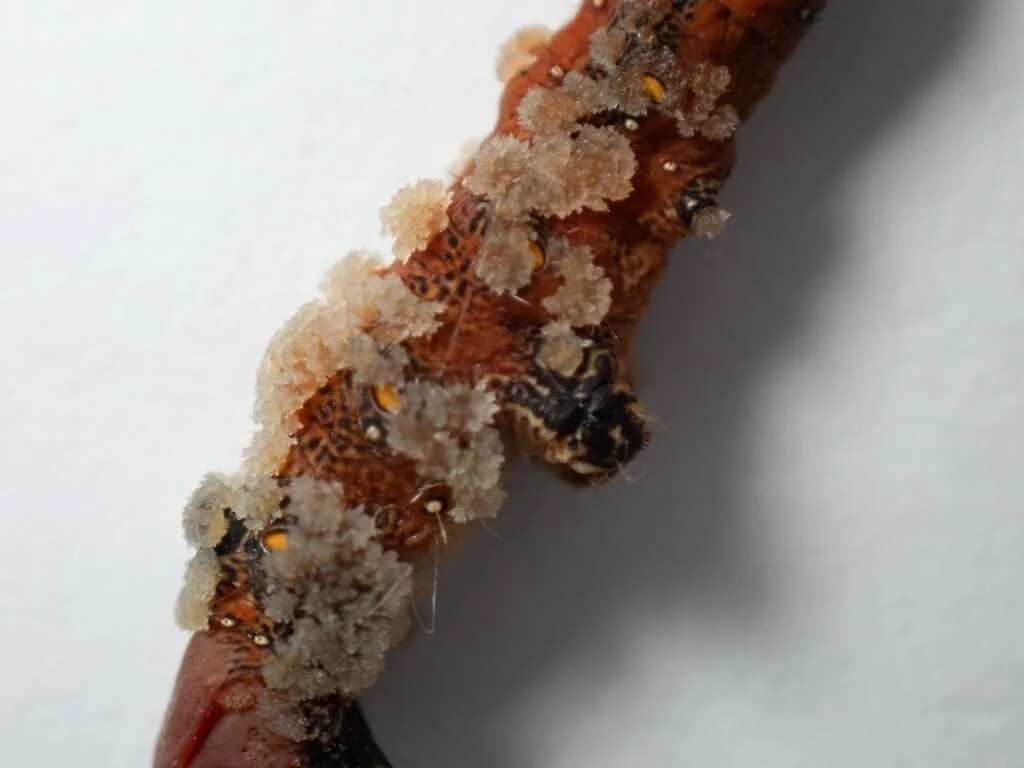
Cauliflower-like growths on a Mallee Looper caterpillar, possibly caused by Entomopthera, an Entomopathogenic Fungi (EPF)
Bacteria - Bacillus thuringiensis var. kurstaki (Btk)
This is a common soil-borne bacterium.
Method of spread: This naturally occurring bacterium contains a toxin that causes caterpillars to starve, shrivel and turn black. The bacterium is spread when caterpillars eat contaminated foliage.
Appearance: Larvae become lethargic and darken from brown to black upon death. They shrivel but do not liquefy. They often have a foul odour.
Biocontrol potential: Commercial formulations are readily available (even in Bunnings!) and are most effective on early (first to third) instar caterpillars. For Mallee Loopers, this is when the caterpillars are less than 15 mm long, before they are really noticeable. The product must be sprayed over foliage but it degrades within days with exposure to sunlight and can be washed off by rainfall.
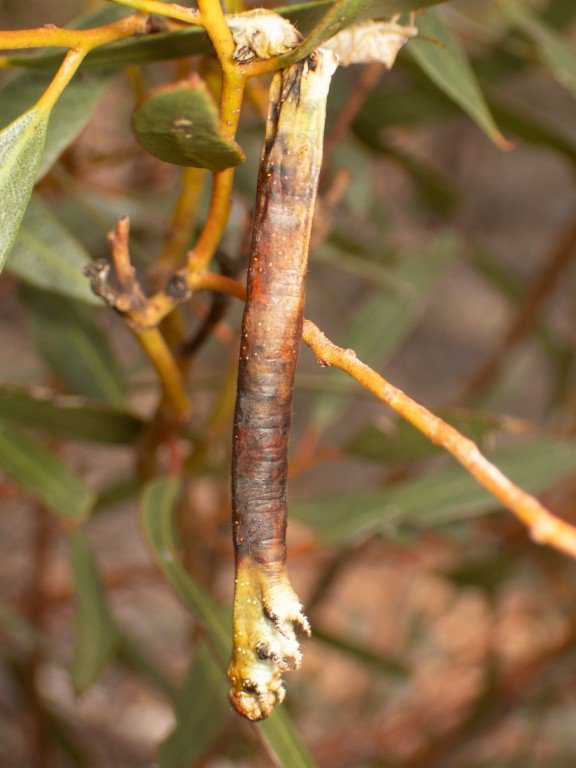
A dead Mallee Looper hanging by its anal claspers. the body is starting to discolor. Killed by an unidentified pathogen.
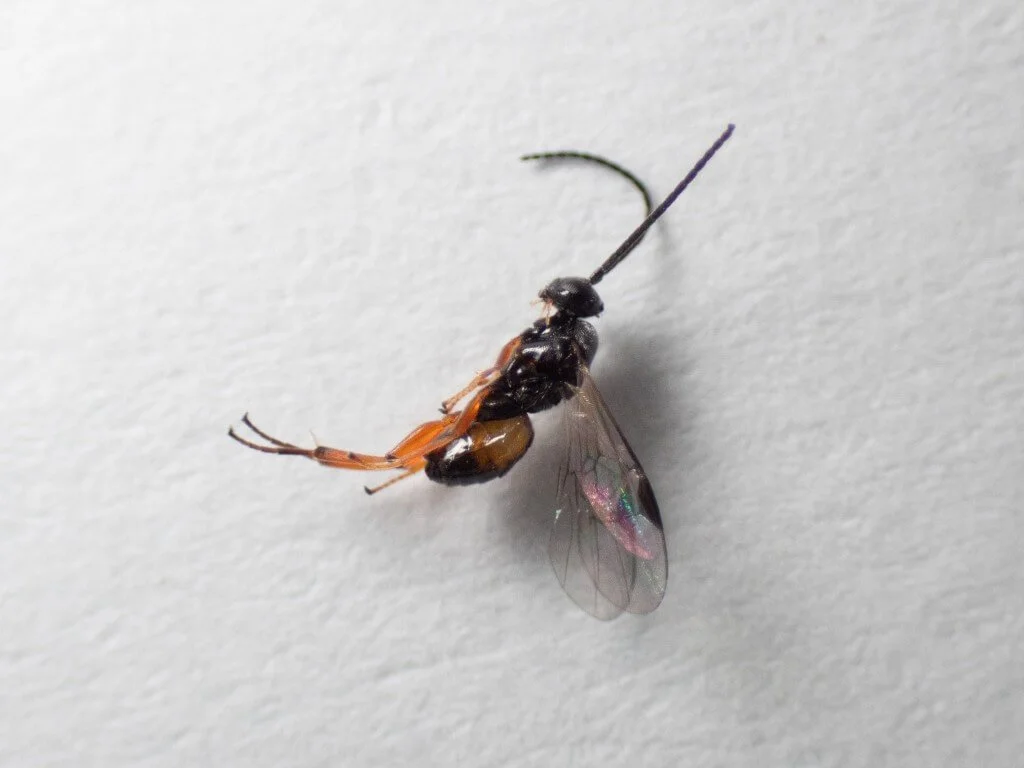
Parasitoid - Brachonid wasp
Subfamily Microgastrinae: Cotesia sp.
Parasitoids kill their host, parasites do not.
Method of spread: The wasp injects her eggs into the body of an early (usually second) instar caterpillar. The larvae grow inside the body before cutting their way out through the skin of the still living caterpillar. In Mallee Loopers the wasp larvae emerge from the fifth (penultimate) instar. Totally gross but it gets weirder.
The adult wasp also injects a virus into the caterpillar. After the wasp larvae emerge, they spin cocoons to pupate in. The virus affects the caterpillar central nervous system and the caterpillar becomes a bodyguard, protecting the cocoons until the adult wasps emerge. Then the caterpillar dies. Seriously.
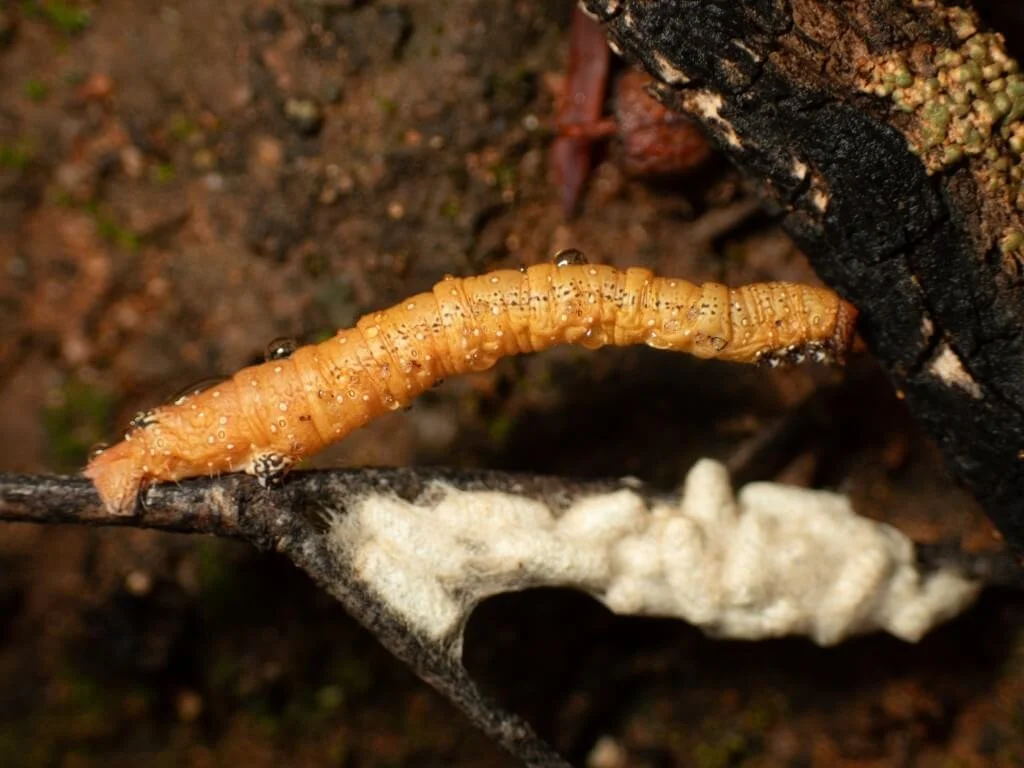
A Mallee Looper caterpillar acting as bodyguard to the cocoons of a Braconid wasp (possibly Cotesia sp.). The larvae of the wasp grew inside the body of this caterpillar.
Biocontrol potential: Cotesia spp. are widely reared and released for control of all sorts of agricultural pests.
For the Mallee Looper in the wild, the effectiveness of the wasps may be limited by the prevalence of hyper parasitoids that parasitise the parasitoids ... Also, the wasps will likely need a secondary host because when they emerge from the fifth instar Mallee Looper, there are very few small Loopers about to lay their eggs into.
A good start would be to identify this promising wasp! There are 21 Australian species of Cotesia and only C. geometridae is known to parasitise a Geometrid caterpillar (Autumn Gum Moth Mnesamplea privata). This Australian Gum Moth is also parasitised the very similar looking Glyptapanteles mnesamplea wasps. The wasps are believed to be important for “regulation and prevention of an outbreak, rather than as a method of control when an outbreak is occurring”.
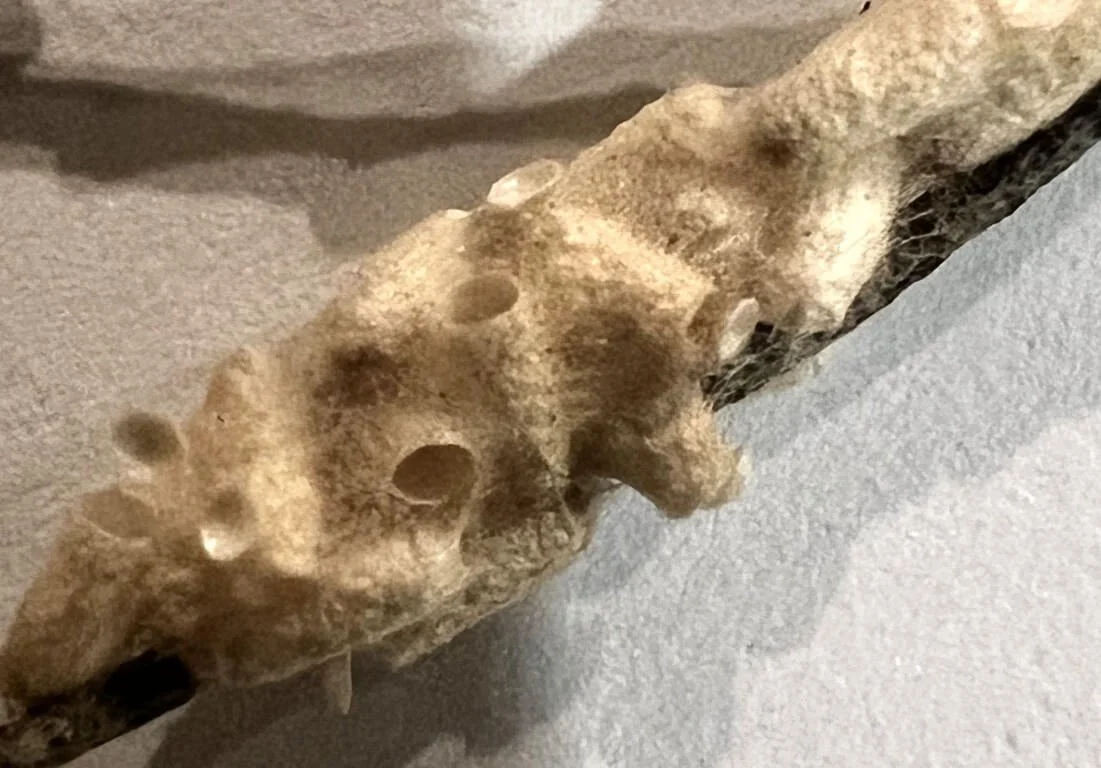
What causes caterpillar outbreaks to collapse?
In general, it’s a combination of natural control agents (predators, pathogens, parasitoids), plus reductions in food quantity or quality, and weather events that cause insect outbreaks to crash.
So it appears that there is unlikely to a be a silver bullet that will end the Mallee Looper outbreak. In an outbreak of Spongy Moth (Lymantria dispar: Erebidae) in Austria a complex of natural enemies, including seven parasitoids and three pathogens, together contributed to collapse of the population. For this species, two disease-causing pathogens are most important: a strain of NPV (virus), and Entomophaga (fungus).
I guess we will have to keep watching and learning more about the Mallee Looper.
References:
Schellenberg’s Soldier Beetle:
Cooper (1981) “The role of predatory Hemiptera in disseminating a nuclear polyhedrosis virus of Heliothis punctiger”.
Pathogens
Notes on insect pathogens - Insect pathology manual.
Braconid wasp
McMillan et al. (2024) The caterpillar Manduca sexta brain shows changes in gene expression and protein abundance correlating with parasitic manipulation of behaviour
Schumacher et al (2000) Parasitoids of the autumn gum moth, Mnesampela privata (Guenée) (Lepidoptera: Geometridae) in South-Eastern Australia, with description of two new larval parasitoids Full text available here
Spongy moth
Hajek and Roberts (1992) Field Diagnosis of Gypsy Moth (Lepidoptera: Lymantriidae) Larval Mortality Caused by Entomophaga maimaiga and the Gypsy Moth Nuclear Polyhedrosis Virus
Zanki et al. (2023) “Parasitoids and pathogens in a collapsing Lymantria dispar (Lepidoptera: Erebidae) population in Lower Austria”