
Egg laying in the Mallee Looper moth
From mid November 2025 to early January 2026, we set traps to record the abundance of Mallee Looper moths in the Victorian Mallee. But we were also interested in collecting eggs from the female moths, and learning how the caterpillars disperse away from the egg mass.
Why? Because a detailed understanding of the life history of the Mallee Looper (Arhodia sp.) is critical to help us understand why they have become superabundant in recent years.
How many eggs does a moth lay?
Well it depends on the size of the moth. I measured the forewing length of 56 female Mallee Looper moths and counted how many eggs they laid. The smaller moths had a forewing length of 16-20 mm and laid about 200-400 eggs. Most moths had a forewing length of 20-24 mm and laid 400-700 eggs. But I had one huge female with a forewing length of 26 mm and she laid 966 eggs!
Okay, a couple of things. It was quite tedious counting those eggs. They are less than 1 mm in diameter. I took photos of the egg masses and hoped AI could help me. It could not. I did however find this nifty website that allows you to mark up your photos and number each egg so you don’t lose track. Thank you https://mrcount.co/landing Here’s the eggs in a 10 cm diameter petri dish and the process of counting:
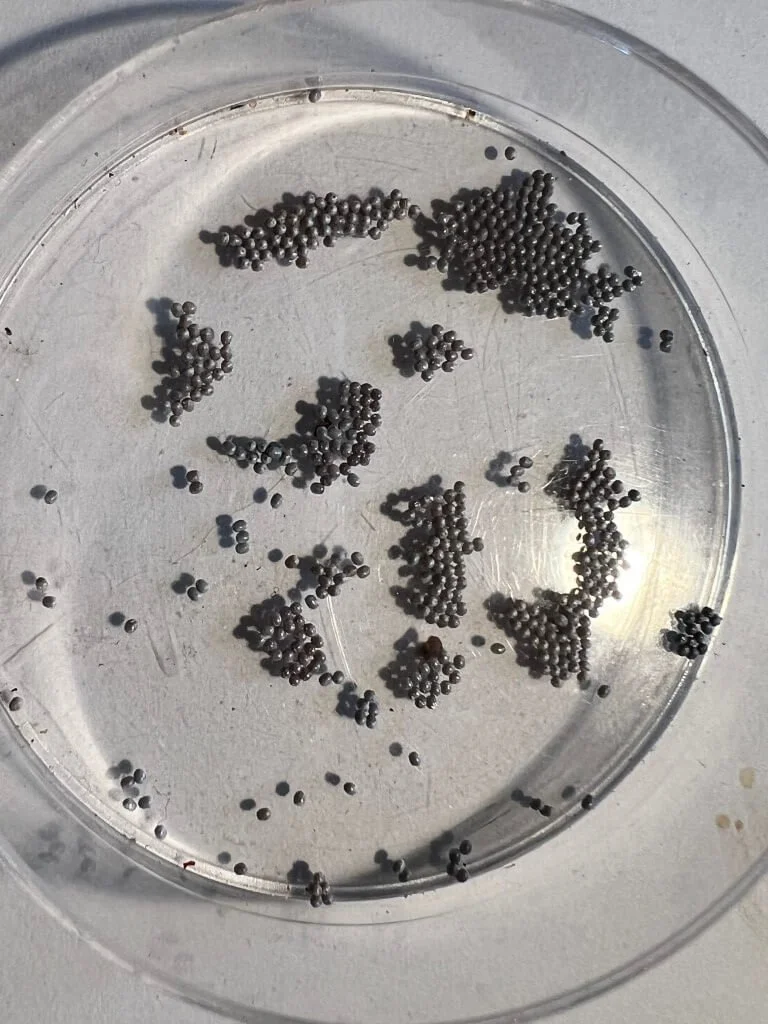
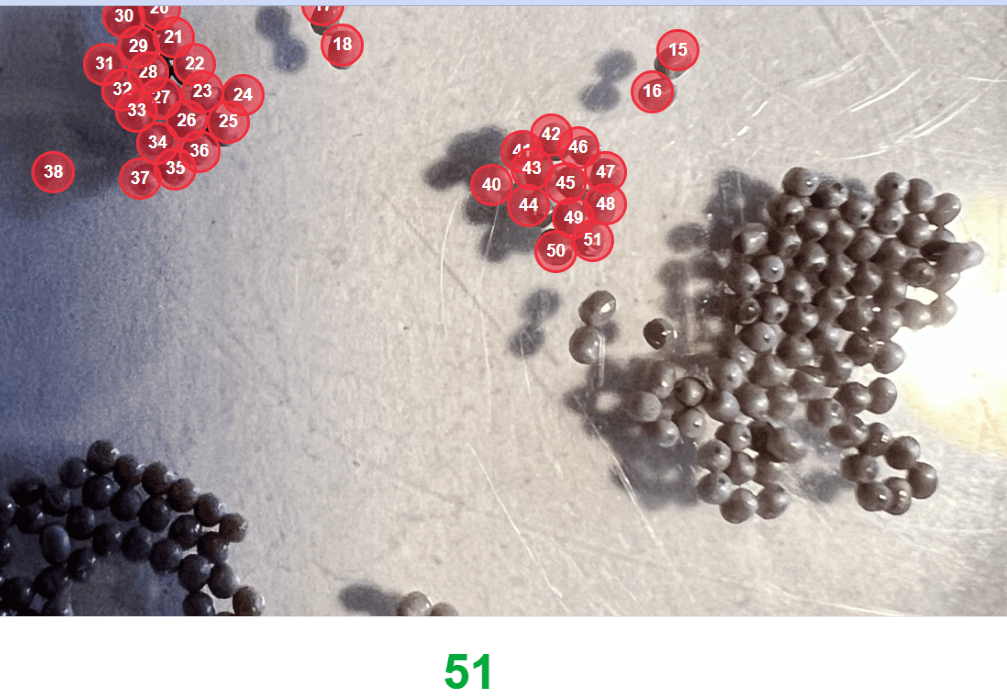

Secondly, that’s a lot of eggs per moth, and that could equate to lots of caterpillars. Freshly laid eggs were pale grey, becoming dark grey immediately before they hatched. And they all hatched. I didn’t observe any parasitism of the eggs at all. I just kept them in petri dishes until, ten days later, the dishes were filled with tiny, wriggling first instar larvae and white, empty eggshells. (Read more about the caterpillar rearing here).
Egg laying in the wild
We also spent time wandering about at night observing where moths choose to lay their eggs in the wild. Thanks to Mark Hura and others, we recently discovered that Mallee Loopers like to lay their eggs in exposed locations like dead twigs at the top of trees. I was lucky to observe this female laying eggs.
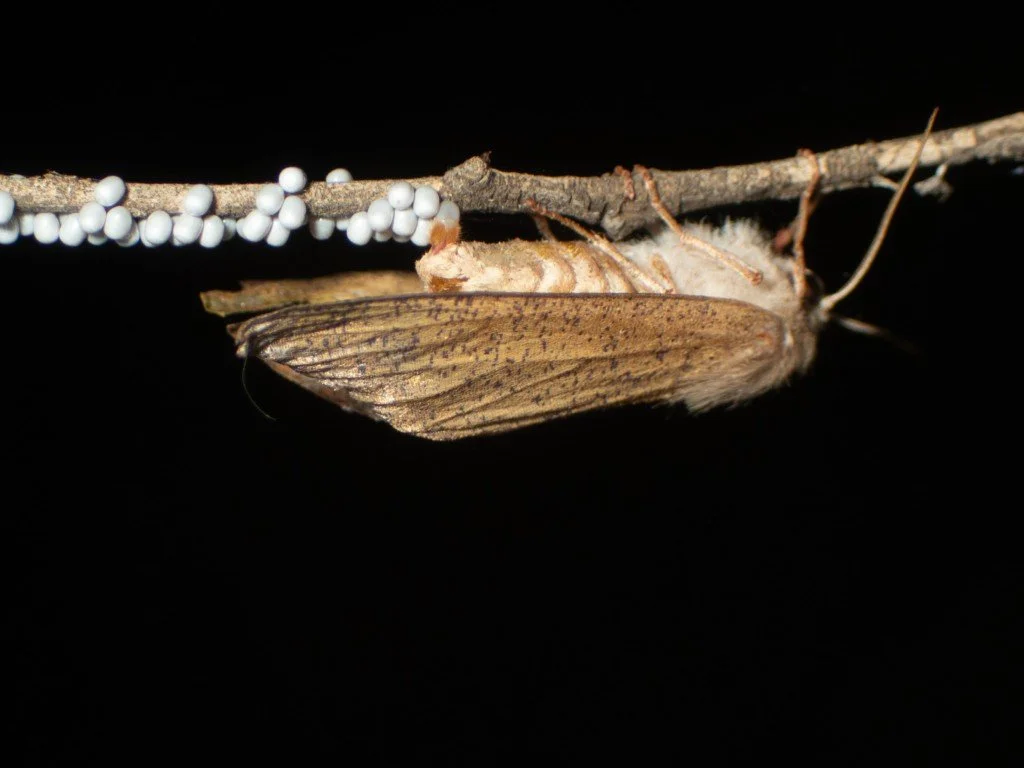
Mallee Looper moth laying eggs on an exposed twig.
And we also found egg masses like this that had already hatched.
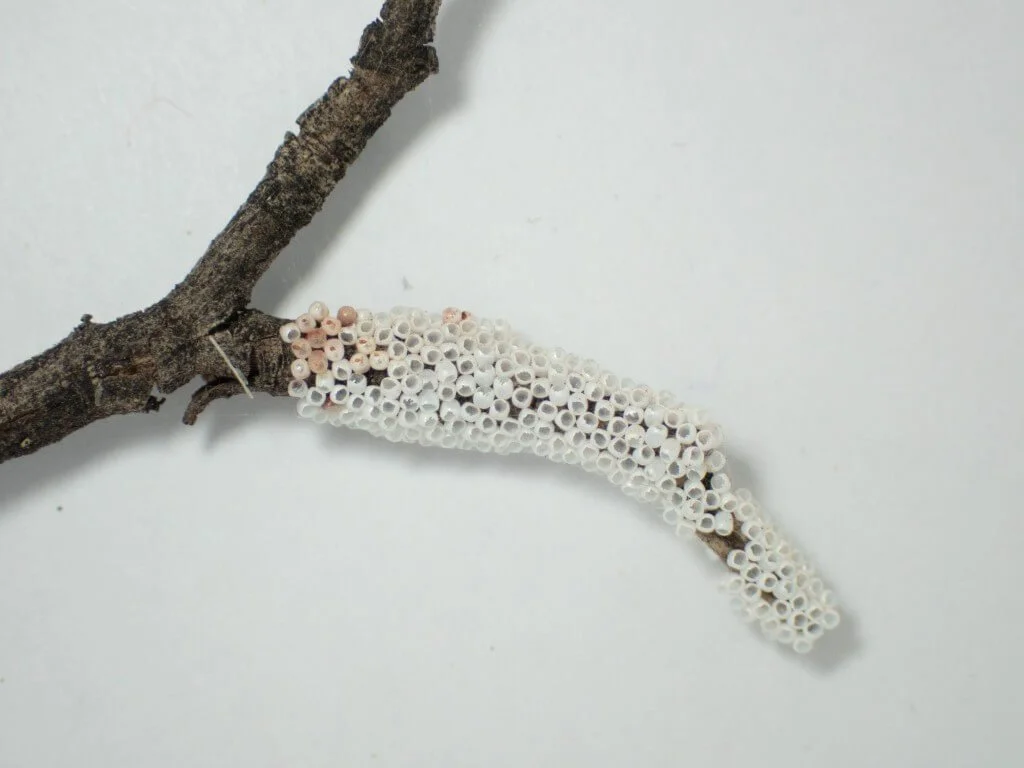
A Mallee Looper egg mass on a twig, these eggs have hatched.
Caterpillars go ballooning
We suspected that egg-laying on dead twigs in exposed locations could be to aid dispersal of the tiny caterpillars. The keen eyes of Rebecca Arnold noticed masses of silk threads associated with tiny Loopers. But we didn’t know the full story until the amazing Mark Hura erected this scaffold on his property to monitor the egg masses. He counted over 160 egg masses in the tree nearest!
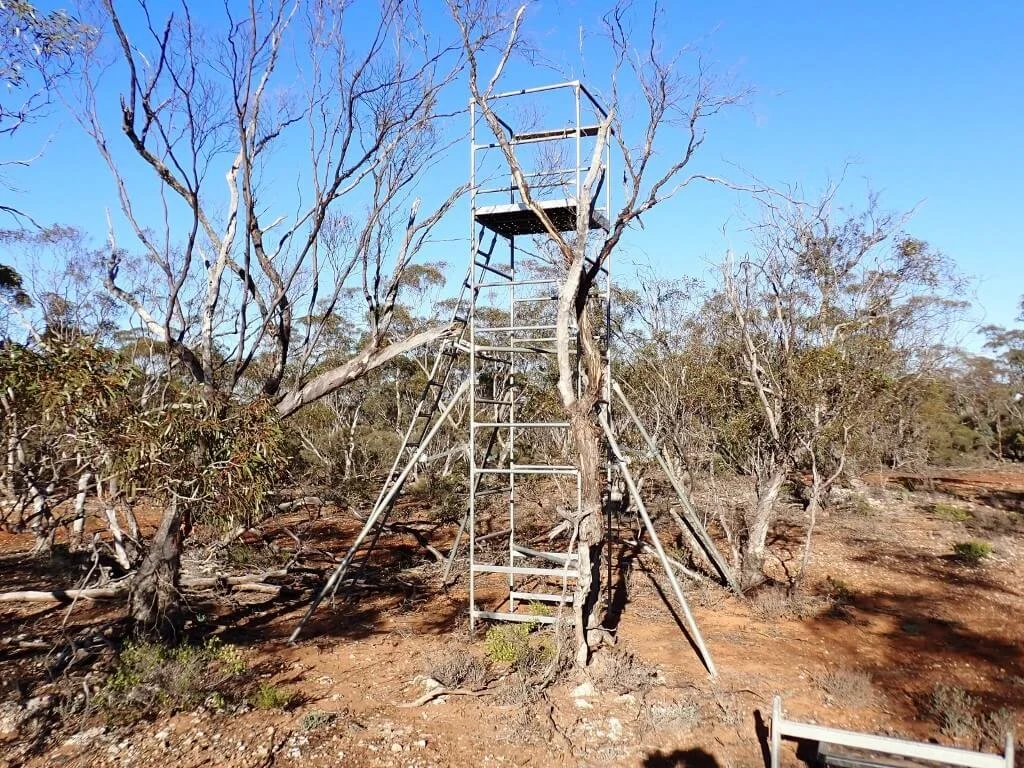
Scaffolding erected in South Australia to monitor emergence of Mallee Looper caterpillars from the egg (Image: Mark Hura)

Mallee Looper caterpillars freshly emerged from the egg. These will drop down on a silken thread and “balloon” away on the wind. (Image: Mark Hura)
He made some incredible observations (summarised from his email 17 December 2025):
The majority of the caterpillars from a single egg mass emerge within a few minutes of each other, resulting in a large congregation. They initially hold on to the egg masses for several minutes before suddenly dropping down, and hanging by silk threads. The next strong breeze breaks the thread and the caterpillars drift away on the wind (ballooning). The large numbers of caterpillars and their threads results in a fine silk netting among the twigs on the trees, similar to spider webs.
Newly emerged Mallee Looper caterpillars “balloon” away from the egg mass on a gust of wind. This is a form of dispersal.
This project of the Regional Drought Resilience Planning program is jointly funded through the Australian Government’s Future Drought Fund, the Victorian Government and the Natural Resources Conservation Trust.